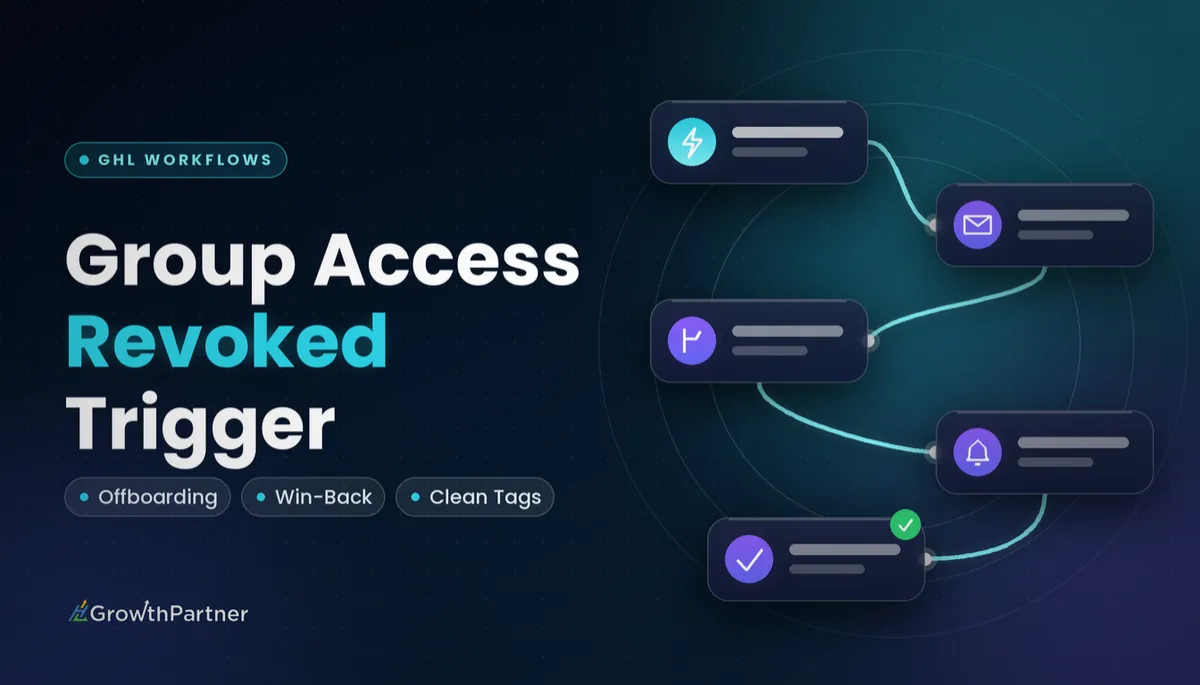
GoHighLevel Group Access Revoked Trigger: Setup Guide (2026)
 By Dr Priya Jaganathan, GoHighLevel Certified Admin · HL Growth Partner, Australia · Updated 14 November 2026 · 10 min read
How to set up the Group Access Revoked trigger in HighLevel Workflows, with four offboarding and win-back recipes and a checklist for when it stays silent.
Some links below are affiliate links — if you sign up through them, HL Growth Partner may earn a commission at no extra cost to you. It never changes what we recommend.
The GoHighLevel Group Access Revoked trigger starts a workflow after a member loses access to a specific Communities group. It is the natural home for offboarding messages, tag clean-up, pipeline moves, team alerts and win-back sequences.
Most community owners build a lovely welcome flow and nothing for the way out. This guide covers setup, four recipes, look-alike triggers, and how to test a HighLevel group access revoked workflow before a real member leaves.
| Trigger category | Communities |
| Fires when | A member's access to the selected group is removed |
| Setup | Create a workflow, choose the trigger, select the group |
| Paired action | Revoke Group Access (makes the change inside a workflow) |
| Opposite trigger | Group Access Granted |
| Where to check runs | The workflow's enrolment history |
| Source | HighLevel help centre, 2026 |
What the GoHighLevel Group Access Revoked trigger actually fires on
Per HighLevel's help centre, Group Access Revoked is a Communities workflow trigger that starts the workflow after a member's access to the selected group is removed. You create the workflow, choose the trigger and pick the group. That's the whole configuration.
The trigger reacts to the access change, not to the reason behind it. A member who cancels, a card that keeps declining, a refund, or an admin removing someone by hand can all end in the same revoked access. The trigger on its own doesn't tell you which one happened.
That matters for tone. A "sorry to see you go" email suits a voluntary leaver, not someone whose card failed and who would happily stay. I'll show you how to split those paths below.
Still setting up groups and offers? Our GoHighLevel Communities guide explains how the pieces connect.
How to set up a HighLevel group access revoked workflow, step by step
Create and publish the group in Communities first so you can select it.
- Go to Automation → Workflows in the sub-account and create a new workflow from scratch.
- Click Add New Trigger and choose Group Access Revoked from the Communities triggers.
- Select the specific group this workflow should respond to.
- Rename the trigger so it reads clearly in the builder, for example "Revoked: Inner Circle group".
- Add your actions below the trigger (see the recipes below).
- Open the workflow Settings and decide whether contacts may re-enter if they rejoin and leave again.
- Save, publish, and run a test contact through it before relying on it.
One group, one revoked workflow is my default. It keeps enrolment history readable and stops a goodbye written for your free group from reaching ex-members of your paid group.
Members do leave and come back, and with re-entry off, their second exit won't run the workflow. Our guide to workflow re-entry settings walks through when to allow it.
Revoked trigger versus Revoke Group Access action
HighLevel's article on automating community group access draws a clean line. Triggers respond after a change; actions make the change. Group Access Granted and Group Access Revoked are triggers. Grant Group Access and Revoke Group Access are actions.
A typical build chains them: a cancellation workflow runs Revoke Group Access, which then fires your separate Group Access Revoked workflow for messaging and clean-up.
Four Group Access Revoked recipes worth building
These are the exit builds I set up most often in client sub-accounts.
Recipe 1: Offboarding email and tag clean-up
- Trigger: Group Access Revoked, set to your group.
- Action: Remove Tag for the active-member tag, such as community-inner-circle-active.
- Action: Add Tag for a former-member tag, such as community-inner-circle-former.
- Action: Send Email confirming access has ended, what they keep (if anything), and how to rejoin.
The tag swap matters most: anything checking the active tag now treats this person correctly.
Recipe 2: Pipeline move and team alert
- Action: Create or Update Opportunity, moving the contact to a "Left community" stage in your member pipeline.
- Action: Internal Notification (email or SMS) to the community manager with the contact's name and group.
- Action: Create Task to review the account within two business days, for higher-value members.
Recipe 3: Churn reasons survey
- Wait: 1 day, so the survey doesn't land in the same minute as the access email.
- Action: Send Email or SMS with a link to a short HighLevel survey asking why they left.
- Survey design: one multiple-choice question (price, time, content, technical issues, other) and one optional free-text box.
- Follow-up: a separate survey-submitted workflow that writes the answer to a custom field and tags the reason.
Churn reasons stored as custom fields become reportable. After a few months you can see whether people leave over price or over content, which is the difference between discounting and fixing the product.
Recipe 4: Win-back sequence
- Wait: 14 to 30 days, depending on your billing cycle.
- If/Else: does the contact already have the active-member tag again? If yes, end the branch.
- No branch: send a win-back email with what's new in the group and a link to rejoin through the offer.
- Optional: one second touch a week later, then stop.
The If/Else check stops you pitching a comeback to someone who already came back. Former members who stay quiet for months are a good fit for a broader database reactivation campaign later on.
Voluntary leave or payment failure? Pair it with Subscription and Refund triggers
Because the trigger doesn't carry the reason, let payment-side workflows label it first.
- A Subscription trigger workflow watches for cancellations and failed payments, and adds a reason tag such as exit-cancelled or exit-payment-failed.
- A Refund trigger workflow adds exit-refunded when money goes back.
- The Group Access Revoked workflow then uses If/Else on those tags to send the right message.
Payment-failed members get a "please update your card" message, not a farewell. Refunded members get a neutral confirmation. Voluntary leavers get the survey and the win-back.
Add a short wait before the If/Else so the payment-side tags have time to land, and test that timing in your own account.
The revoked trigger tells you someone walked out the door. Your tags decide whether you wave goodbye, fix their card, or quietly leave them alone.
Group Access Revoked vs similar triggers and actions
Several membership automations sound almost identical. Here's how they differ.
| Trigger or action | What it does | Best for |
|---|---|---|
| Group Access Revoked (trigger) | Starts a workflow after a member's access to the selected group is removed | Community offboarding, tag clean-up, win-back |
| Group Access Granted (trigger) | Starts a workflow after a member is given access to a group | Welcome messages, onboarding tasks, member tags |
| Offer Access Removed (trigger) | Starts a workflow when access to a membership offer is removed | Exits from bundles of courses and groups; running Revoke Group Access |
| Product Access Removed (trigger) | Starts a workflow when access to a course product is removed | Course-side offboarding, separate from the community |
| Revoke Group Access (action) | Removes a contact's group access as a step inside a workflow | Cancellation and payment-failure workflows that need to cut access |
If one offer bundles a course and a group, decide which workflow sends the goodbye, or one cancellation can produce several exit emails. The opposite-direction build is covered in our Group Access Granted trigger setup guide.
Not on HighLevel yet? Start with a free 30-day trial here — long enough to build everything in this guide before you pay a cent.
How to test the revoked trigger before a real member leaves
Never test on a paying customer. Give a test contact group access, then remove it the same way real members lose it.
- Match the real path. If access is normally removed by a cancellation workflow, test through that workflow, not just a manual removal.
- Shorten waits. Drop long waits to minutes while testing, then restore them.
- Test each branch. Run one test contact with each exit reason tag and one with none.
- Test a rejoin. Grant access again, revoke it again, and confirm re-entry behaves the way you intended.
Check HighLevel's official Group Access Revoked trigger article for any changes to the trigger's settings, since Communities is updated often.
Troubleshooting a Group Access Revoked workflow that didn't run
Start with the workflow's enrolment history. No enrolment record means the trigger never matched, so the problem sits upstream of your actions.
- Is the workflow published, or still in draft?
- Is the trigger set to the right group? Duplicated groups with similar names catch people out.
- Was group access actually removed, or did the member only lose access to an offer or course?
- Was the contact already enrolled with re-entry switched off?
If the contact enrolled but nothing arrived, open the execution logs and look for a skipped or failed step: a missing email, a DND contact, a wrong If/Else tag, or an unfinished wait.
One unrelated message to watch for: HighLevel can show a "trigger group access revoked"-style permission warning when the workflow owner loses permission to a resource the trigger uses. Fix the user's permission rather than rebuilding the workflow.
Common mistakes to avoid
- Building a welcome flow for every group and no revoked workflow, so ex-members keep active tags and keep receiving member-only emails.
- Sending the same farewell to voluntary leavers and payment failures, instead of splitting on exit-reason tags.
- Confusing the Group Access Revoked trigger with the Revoke Group Access action and putting both jobs in one workflow.
- Running exit emails from both Offer Access Removed and Group Access Revoked workflows, so one cancellation sends two goodbyes.
- Starting a win-back sequence without an If/Else check for members who have already rejoined.
- Treating the owner permission warning as a broken trigger and rebuilding a workflow that was working.
Or if you just need the software first: grab the 30-day HighLevel trial and book us when you're ready to scale it.
Frequently asked questions
What does the GoHighLevel Group Access Revoked trigger do?
It is a Communities workflow trigger that starts a workflow after a member's access to a selected group is removed. You choose the group in the trigger, then add actions such as offboarding emails, tag changes, pipeline moves, team alerts or a win-back sequence.
How do I set up the Group Access Revoked trigger?
Create a workflow in Automation, add a new trigger and choose Group Access Revoked from the Communities triggers. Select the group the workflow should respond to, add your actions, decide on re-entry in Settings, then publish and test with a test contact.
What is the difference between the Group Access Revoked trigger and the Revoke Group Access action?
The trigger responds after a member's group access has been removed. The Revoke Group Access action is a workflow step that removes a contact's access. A common build uses the action in a cancellation workflow and the trigger in a separate offboarding workflow.
Can the Group Access Revoked trigger tell me why a member left?
The trigger reacts to the access change, not the reason behind it. To tell voluntary cancellations from payment failures or refunds, use Subscription and Refund trigger workflows to add exit-reason tags, then branch on those tags with If/Else in the revoked workflow.
Should I use Offer Access Removed or Group Access Revoked for offboarding?
Use Group Access Revoked when the message is about leaving the community itself, because it fires on the group access change. Use Offer Access Removed when an offer bundles several courses and groups and you want one exit message for the whole bundle. Pick one so members don't receive two goodbyes.
Why didn't my Group Access Revoked workflow fire?
Check the workflow's enrolment history first. If the contact isn't there, the workflow may be in draft, the wrong group may be selected, access may not actually have been removed, or re-entry may be switched off. If the contact enrolled but nothing arrived, check the execution logs for a failed or skipped step.
What does a "trigger group access revoked" permission warning mean?
HighLevel can show a permission warning when the workflow owner loses permission to a resource the trigger uses. It concerns the user's access, not a community member's, so restore the user's permission instead of rebuilding the workflow.
Related Articles on HL Growth Partner
More membership and course triggers
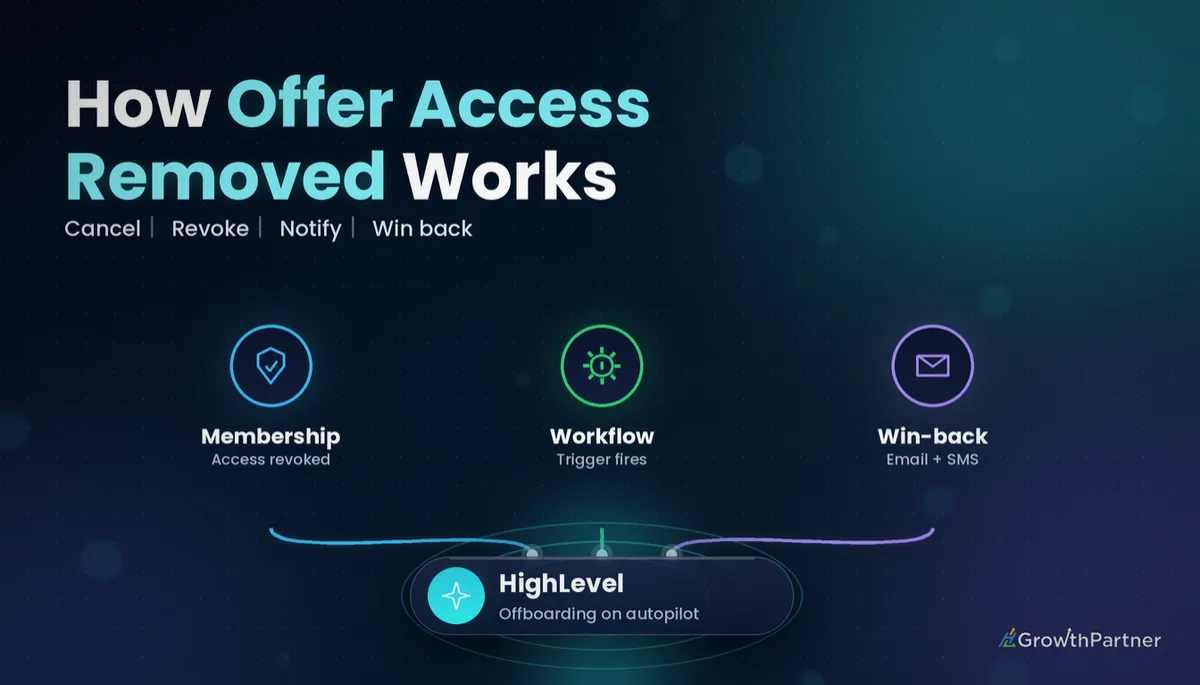 GoHighLevel Offer Access Removed Trigger: Setup Guide (2026)
 GoHighLevel Product Access Removed Trigger: Setup Guide (2026)
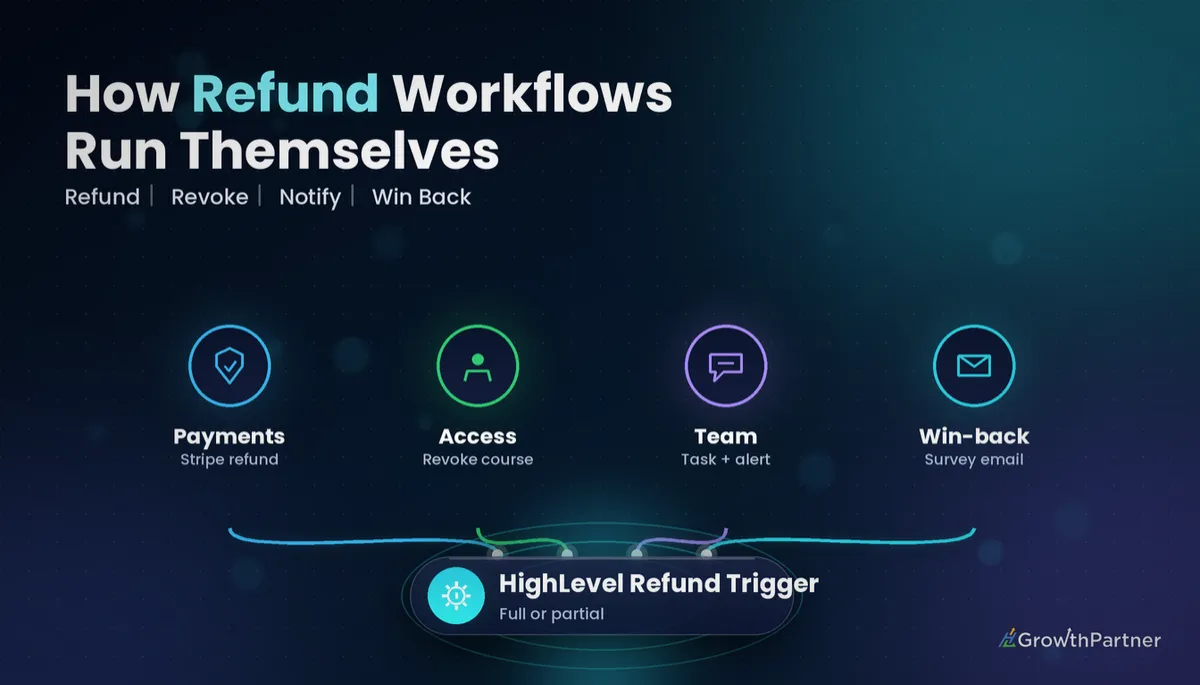 GoHighLevel Refund Trigger: Setup Guide (2026)
Building smarter workflows
 GoHighLevel Workflow Triggers Explained: Complete 2026 Reference
 GoHighLevel Workflow Trigger Filters Explained