Measure the ROI of GoHighLevel: KPIs Every Growing Business Should Track
GoHighLevel ROI, CRM Analytics, Business Automation
Learn how to turn GoHighLevel from “just another CRM” into a measurable growth engine by tracking the right KPIs, not just activity and logins.
Introduction: When “Set and Forget” Doesn’t Deliver
Six months after rolling out GoHighLevel, a Wellington-based service business owner sat staring at a screen full of contacts, pipelines, and automations and asked a simple question: “Is this actually working?” They had invested in GoHighLevel implementation, moved their forms and funnels, and turned on a few marketing automation workflows. The team was busier than ever, but the owner still couldn’t answer core questions with confidence.
Were their GoHighLevel workflows really saving time, or just adding noise? Which campaigns and channels were bringing in quality leads? Was the CRM improving customer retention, or were clients quietly slipping away? Most importantly, was the investment in GoHighLevel ROI positive, or just another software subscription on the books?
The problem wasn’t the platform. It was that they were not measuring the right CRM performance metrics. To get meaningful CRM ROI, you need to link GoHighLevel reporting directly to business outcomes: efficiency, revenue growth, customer lifetime value, and operational improvements. In this guide, we’ll show you exactly which KPIs to track and how to turn your GoHighLevel dashboards into a decision-making system, not just a data warehouse.
Why Measuring CRM ROI Matters
Many businesses across New Zealand invest in CRM software, migrate from tools like HubSpot, Salesforce, Zoho, Pipedrive, Keap, Kajabi or ClickFunnels, and then never clearly define what success looks like. They assume that once GoHighLevel is live, growth will follow automatically. Without clear CRM analytics and KPIs, it’s impossible to know whether that’s actually happening.
Better business decisions: When you can see which funnels, offers, and campaigns generate revenue, you can double down on what works and stop guessing.
Budget optimisation: Clear marketing automation ROI data helps you shift budget away from underperforming channels and into high-ROI activities.
Team accountability: Sales pipeline KPIs and activity metrics make it obvious where leads are stalling and who needs support or coaching.
Marketing effectiveness: GoHighLevel reporting on email, SMS, and funnel performance shows whether your campaigns are building a predictable pipeline or just generating noise.
Operational efficiency: Business automation metrics such as hours saved and tasks automated translate directly into lower costs and more capacity.
Long-term scalability: A CRM that’s measured and optimised becomes the backbone of growth, not a bottleneck you outgrow in two years.
Ultimately, you want to measure outcomes, not just activity. Logins, emails sent, and number of pipelines created are useful signals, but they are not the goal. The goal is profitable, sustainable growth and that’s where a clear GoHighLevel ROI framework comes in.
What Does ROI Mean in GoHighLevel?
In simple terms, ROI is the value you get back compared to what you put in. With GoHighLevel, that value is much more than just extra revenue. For most SMEs, coaches, agencies, and service businesses, GoHighLevel ROI shows up in three main areas: money earned, money saved, and risk reduced.
Time saved: Automated follow-ups, pipelines, and AI workflows free your team from repetitive tasks so they can focus on higher-value work.
Revenue generated: Better lead management, faster responses, and consistent nurturing increase the number of deals closed and the size of each customer’s spend.
Faster response times: When leads get a near-instant reply via SMS, email, or Voice AI they are far more likely to book and buy.
Higher conversion rates: Structured pipelines and automated reminders reduce leakages where warm prospects quietly disappear.
Better customer retention: Consistent onboarding, review requests, and reactivation campaigns keep customers engaged for longer, lifting customer lifetime value.
Reduced manual work: Consolidating tools into GoHighLevel cuts subscription bloat and reduces the admin load of managing multiple platforms.
Improved reporting: Clear CRM analytics and GoHighLevel dashboards mean you can see your numbers in one place instead of piecing them together from spreadsheets.
More predictable sales: When you know your conversion rates and pipeline velocity, you can forecast revenue with far more confidence.
You don’t need complex financial formulas. You need a simple view: “We invest this much each month into GoHighLevel and related services, and we get this much back in revenue, time savings, and customer value.”
The 10 KPIs Every Growing Business Should Track
KPI 1: Lead Response Time
Lead response time measures how quickly your team (or automations) follow up once a new lead hits your CRM. In most markets, the first business to respond has a huge advantage. GoHighLevel makes it easy to trigger instant SMS or email replies and route leads to the right salesperson.
Practical tip: Set a workflow so every new lead gets a personalised SMS within five minutes and an automatic reminder for your team if no call is logged within two hours.
KPI 2: Lead-to-Customer Conversion Rate
This KPI tracks the percentage of leads that become paying customers. It’s one of the most important CRM performance metrics because it shows how effectively your sales process works end-to-end. With clear GoHighLevel reporting on each pipeline stage, you can see where leads stall whether it’s at booking, proposal, or follow-up and fix those bottlenecks.
KPI 3: Customer Acquisition Cost (CAC)
CAC is the total cost of winning a new customer, including ad spend, software, and sales time. When your business automation is set up correctly, GoHighLevel reduces CAC by automating follow-ups, qualifying leads earlier, and ensuring no opportunity is missed. Over time, better automation and AI workflows mean you can acquire more customers with the same or lower spend.
KPI 4: Customer Lifetime Value (CLV)
CLV measures the total revenue you expect to earn from a customer over the life of your relationship. For most SMEs, improving CLV delivers more CRM ROI than simply chasing more leads. GoHighLevel helps by automating onboarding, upsell offers, reviews, and reactivation campaigns so customers stay longer, buy more often, and refer others.
KPI 5: Sales Pipeline Velocity
Pipeline velocity looks at how quickly leads move from first contact to closed sale. Slow-moving pipelines tie up cash flow and create uncertainty. With GoHighLevel dashboards, you can see average days in each stage and use automation to nudge deals forward such as reminders, deadline-driven offers, or task assignments to your team.
KPI 6: Appointment Booking Rate
For many service-based businesses, the key conversion is from lead to booked appointment. GoHighLevel’s calendars, funnels, and automation can dramatically increase this rate by removing friction and sending timely reminders. Track how many leads book a call within seven days of opting in, and optimise your booking pages and follow-up workflows accordingly.
KPI 7: Customer Retention Rate
Retention rate shows the percentage of customers who continue buying from you over time. Automated nurture sequences, check-in messages, and review campaigns inside GoHighLevel play a huge role here. Even a small lift in retention can significantly increase overall CRM ROI because you’re earning more from customers you’ve already paid to acquire.
KPI 8: Marketing Campaign Performance
GoHighLevel reporting gives you a consolidated view of your campaigns. At a minimum, track:
Email engagement (opens, clicks, replies)
SMS performance (delivery, responses, opt-outs)
Landing page conversions (visit-to-lead rate)
Lead source quality (which channels produce customers, not just leads)
This is the foundation of marketing automation ROI knowing which journeys and campaigns actually contribute to revenue.
KPI 9: Workflow Efficiency
Workflow efficiency measures how well your business automation is performing. Track:
Number of tasks automated (e.g., follow-ups, reminders, handovers)
Estimated manual hours saved per month
Process consistency (how often steps are missed or delayed)
Team productivity (deals handled or customers managed per person)
These business automation metrics turn “we feel busier” into “we’ve freed up 40 hours a month,” which is far more powerful when assessing CRM ROI.
KPI 10: Revenue Attributed to CRM Activities
Finally, track how much revenue can be directly linked to GoHighLevel activities such as deals created from specific funnels, campaigns, or AI workflows. When your CRM analytics are set up correctly, you can see which campaigns produce closed revenue, not just leads. This is the clearest view of GoHighLevel ROI and helps you make smarter decisions about where to invest next.
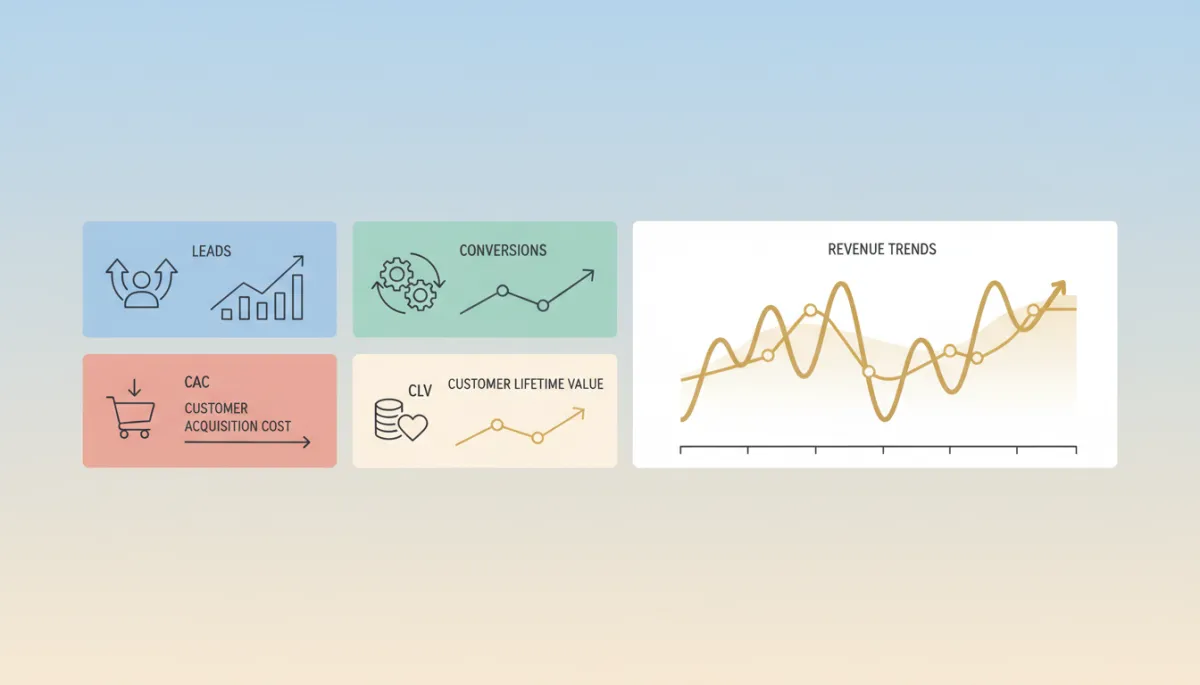
A focused ROI dashboard turns GoHighLevel data into clear business decisions.
Example Story: From Spreadsheets to Clarity in Christchurch
A Christchurch-based accounting firm came to us running their entire sales process from spreadsheets, email inboxes, and a legacy booking tool. Leads slipped through the cracks, no one owned follow-up, and the partners could not say which marketing activities were profitable. They knew they needed a modern CRM but were wary after trying other platforms that never stuck.
After a tailored GoHighLevel implementation, we built clear pipelines, automated lead capture from their website and ads, and configured GoHighLevel dashboards that surfaced their key KPIs: lead response time, appointment booking rate, and revenue by campaign. Lead response became consistent, appointment booking was automated, and marketing performance became measurable instead of anecdotal. The partners could finally see which activities drove new clients and where their team needed support, without relying on guesswork or manual reports.
Common Mistakes Businesses Make When Measuring CRM ROI
Tracking too many metrics: Overloaded GoHighLevel dashboards create confusion. Focus on a small set of KPIs tied directly to your goals.
Focusing only on revenue: Revenue matters, but ignoring time saved, reduced CAC, and higher CLV underestimates true CRM ROI.
Ignoring customer retention: New leads feel exciting, but retention often delivers better long-term returns at lower cost.
Poor CRM data quality: Duplicates, missing fields, and inconsistent stages make CRM analytics unreliable. Regular data hygiene is essential.
Not reviewing dashboards regularly: A dashboard you never open won’t help. Schedule monthly reviews and treat them as non-negotiable leadership meetings.
Measuring activity instead of outcomes: Calls made and emails sent are inputs; focus on booked meetings, sales, and retention as your outcomes.
Working with a specialist GoHighLevel expert in Christchurch, Wellington, or Auckland can help you avoid these traps by designing reporting around your actual business model, not generic templates.
Building an ROI Dashboard in GoHighLevel
A good ROI dashboard should be simple enough to review in 10–15 minutes yet rich enough to guide decisions. We typically structure GoHighLevel dashboards into clear sections:
Leads: New leads by source, cost per lead, and lead response time.
Sales: Pipeline value, conversion rates by stage, and sales pipeline velocity.
Marketing: Campaign performance across email, SMS, and funnels, including key conversion rates.
Customer retention: Active customers, churn, and CLV trends over time.
Workflow performance: Key automations, tasks automated, and estimated hours saved per month.
Team activity: Calls, meetings, and follow-ups completed, tied to outcomes rather than vanity metrics.
Revenue trends: Monthly recurring revenue, one-off sales, and revenue attributed to specific CRM activities.
The goal is not to impress with complexity; it’s to make it obvious what’s working, what’s not, and what to change this month. If you’re unsure where to start, partnering with a GoHighLevel Expert in Auckland or your local region can help you design dashboards that match your growth strategy.
Why Partnering With a GoHighLevel Implementation Expert Improves ROI
GoHighLevel is a powerful platform, but the ROI comes from how it’s implemented and used day-to-day. As an experienced implementation and fulfilment partner, HL Growth Partner focuses on business outcomes first, then configures the technology around them. That includes:
Strategic CRM implementation and migration from tools like HubSpot, Salesforce, Zoho, Pipedrive, Keap, Kajabi, or ClickFunnels.
Custom GoHighLevel dashboards built around your KPIs and reporting needs.
Workflow optimisation and AI automation that reduce manual work and improve consistency.
KPI tracking frameworks and reporting cadences so you review CRM analytics regularly, not once a year.
Staff training so your team actually uses the system and understands how their actions impact CRM ROI.
Whether you’re working with a GoHighLevel Expert in Wellington or a GoHighLevel Expert in Christchurch, the right partner helps you move from “we have a CRM” to “we have a measurable growth engine.”
Quick ROI Improvement Checklist
Define 3–5 measurable business goals for GoHighLevel (e.g., more bookings, higher retention, lower CAC).
Monitor lead response times and set alerts for slow responses.
Review lead-to-customer conversion rates monthly and optimise weak stages in your pipeline.
Track customer acquisition cost by channel and shift budget to high-performing sources.
Measure customer lifetime value and design campaigns specifically to increase CLV.
Audit key workflows quarterly to ensure they still match your processes and offers.
Clean CRM data regularly deduplicate contacts, standardise fields, and archive outdated lists.
Simplify and optimise your GoHighLevel dashboards around decision-making, not vanity metrics.
Review AI workflows to ensure they’re on-brand, compliant, and contributing to real outcomes.
Schedule a monthly CRM performance review with your leadership team and implementation partner.
FAQ: Measuring GoHighLevel ROI
What is ROI in GoHighLevel?
ROI in GoHighLevel is the combined value you gain more revenue, lower costs, and better customer outcomes compared to what you invest in the platform and its implementation. It includes higher conversion rates, improved retention, reduced manual work, and clearer decision-making from strong CRM analytics and reporting.
Which KPIs should every business track?
At minimum, track lead response time, lead-to-customer conversion rate, customer acquisition cost, customer lifetime value, sales pipeline velocity, appointment booking rate, customer retention rate, marketing campaign performance, workflow efficiency, and revenue attributed to CRM activities.
How often should I review my CRM performance?
Most growing businesses benefit from a quick weekly check-in and a deeper monthly review. Weekly reviews keep you close to your sales pipeline KPIs, while monthly reviews allow you to adjust campaigns, workflows, and budgets based on GoHighLevel reporting trends.
Can GoHighLevel calculate ROI automatically?
GoHighLevel doesn’t calculate ROI in one single number by default, but it provides all the CRM analytics you need to do so conversion rates, revenue by pipeline, campaign performance, and workflow metrics. A well-designed dashboard plus clear cost data (ads, software, team time) makes ROI calculation straightforward.
How do AI workflows improve CRM ROI?
AI workflows in GoHighLevel can handle repetitive tasks like drafting emails, responding to simple enquiries, and qualifying leads. This reduces manual workload, shortens response times, and increases consistency all of which contribute to higher conversion rates and lower customer acquisition costs, lifting overall GoHighLevel ROI.
Which reports should business owners review every month?
Focus on pipeline performance, conversion rates by stage, campaign performance (email, SMS, funnels), customer retention and churn, and revenue by source. These GoHighLevel dashboards give you a clear view of both CRM ROI and marketing automation ROI.
How can I improve customer retention using GoHighLevel?
Use automated onboarding sequences, regular check-in messages, review and referral campaigns, and reactivation workflows for inactive clients. Tracking customer retention rate and CLV inside GoHighLevel dashboards helps you see which initiatives are working and where to refine your approach.
What are the most common CRM reporting mistakes?
Common mistakes include tracking too many metrics, ignoring data quality, failing to link reports to clear goals, and not reviewing dashboards regularly. Another big one is focusing on activity metrics instead of outcomes like revenue, retention, and efficiency.
How long does it take to see ROI after implementing GoHighLevel?
Timelines vary, but many businesses begin to see measurable improvements in lead response, booking rates, and visibility within the first 60–90 days of a well-planned GoHighLevel implementation. Deeper gains in CLV and retention typically appear over 6–12 months as nurture sequences and customer journeys mature.
Does HL Growth Partner help businesses measure and improve GoHighLevel ROI across New Zealand?
Yes. HL Growth Partner works with businesses across New Zealand from Auckland to Wellington and Christchurch to design, implement, and optimise GoHighLevel systems with a clear focus on ROI. That includes CRM implementation, dashboard design, workflow and AI automation, KPI tracking, and ongoing optimisation so your investment keeps delivering value as you grow.
Conclusion: Measure What Matters, Then Optimise
The true value of GoHighLevel isn’t measured by how many automations you build or how many contacts you import. It’s measured by the business outcomes you achieve: faster response times, higher conversion rates, stronger customer relationships, better reporting, and more sustainable growth. When you track the right KPIs and design your GoHighLevel dashboards around decisions, CRM ROI becomes visible and controllable.
If you’re ready to move beyond “we have GoHighLevel” to “we can prove GoHighLevel ROI,” book a strategy call with HL Growth Partner. Together, we’ll design, optimise, and measure a GoHighLevel implementation that aligns with your goals, empowers your team, and turns your CRM into a true growth engine for your business.
Related Articles
Go High Level
- GoHighLevel Roles and Permissions: How to Protect Client Data as Your Agency Scales
- How AI Workflows in GoHighLevel Can Save Your Business 20+ Hours Every Week
- How to Build an AI-Powered Productivity System With GoHighLevel for Your Business
