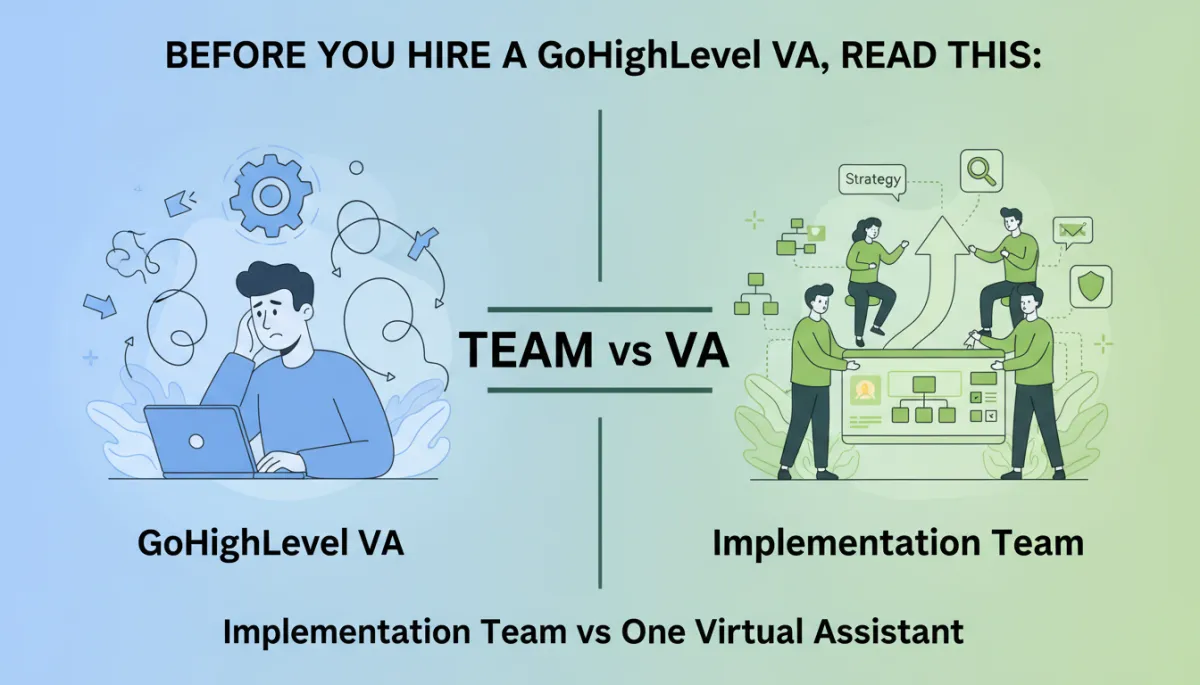
Before You Hire a GoHighLevel VA, Read This: Implementation Team vs One Virtual Assistant
GoHighLevel, CRM implementation, Business automation, Agency fulfilment
Many business owners and agencies reach the same conclusion after a GoHighLevel demo: “This looks powerful I'll just hire a GoHighLevel VA and everything will be handled.” It sounds sensible, especially when you are juggling clients, cash flow, and competing priorities. But as CRM implementations have become more complex and AI-driven, relying on a single virtual assistant can quietly cap your results or create hidden technical debt that surfaces months later.
Virtual assistants absolutely have a place in a GoHighLevel setup. They are often excellent at day-to-day tasks and incremental changes. However, successful CRM implementation in 2026 usually requires a blend of strategy, architecture, automation, AI, and change management skills that rarely sit in one person’s job description. Industry research shows that around 30% of CRM implementations still fail to meet objectives, with more than 60% of issues tied to people and process rather than the technology itself. Treating GoHighLevel as “just another tool to set up” is where many projects go off track.
This article will help you decide whether a single GoHighLevel VA is enough for your business, or whether partnering with a dedicated GoHighLevel implementation team like HL Growth Partner, Australia’s trusted GoHighLevel implementation and fulfilment partner is the smarter path for your next stage of growth.
What Does a GoHighLevel VA Typically Do?
A GoHighLevel VA is usually a capable generalist. They know their way around the platform and can execute a wide range of operational tasks once you give them direction. For many small businesses, this support is genuinely helpful especially when you are moving from spreadsheets or a basic email tool into a more structured CRM environment.
Typical responsibilities of a GoHighLevel VA
Contact management: importing contacts, updating fields, basic segmentation, and list clean-ups when provided with clear rules.
Pipeline setup and maintenance: creating simple sales pipelines, adding stages, and updating opportunities as deals move forward.
Basic workflow automations: building straightforward GoHighLevel workflows such as “new lead → send email and SMS → assign to user” or simple nurture sequences triggered by form submissions or bookings.
Calendar and booking setup: configuring calendars, availability, reminders, and basic appointment workflows so leads can book with your team online or via Voice AI handoff.
Email and SMS campaigns: building one-off or recurring campaigns, loading content, scheduling sends, and monitoring simple performance metrics like opens and clicks using LC Email and the built-in reporting widgets.
Landing pages and funnels: editing existing pages, cloning funnels, updating copy or images, and connecting forms to workflows or pipelines within GoHighLevel’s website and funnel builder.
Forms and surveys: creating or adjusting forms, surveys, and lead capture assets, then mapping fields to contact records and custom fields.
Basic reporting and dashboards: pulling standard reports, exporting data, and screenshotting dashboards for management updates when you specify what you want to see.
Where many GoHighLevel VAs reach their limits
These capabilities are valuable, but they sit mostly at the execution layer. Most GoHighLevel VAs are not hired or compensated as CRM implementation strategists. Common limitations include:
Little or no involvement in sales process design, offer architecture, or customer journey mapping across multiple channels and brands.
Limited experience with complex workflow logic branching paths, conditional triggers, multi-step AI agents, and multi-location routing using Workflow Pro or advanced triggers like failed payments or partial forms.
Minimal exposure to AI automation design such as Conversation AI, Voice AI agents, or Ask AI knowledge bases connected to Google Drive and other data sources.
Limited skill with integrations, APIs, and custom code often relying solely on native integrations or Zapier without deeper architecture planning, error handling, or performance considerations.
Little formal approach to testing, documentation, and governance, which are now critical as GoHighLevel becomes the central nervous system of many agencies and service businesses.
None of this is a criticism of VAs. They are usually doing exactly what they have been asked to do. The question is whether your business goals require more than task execution and whether you want a GoHighLevel specialist team responsible for the bigger picture.
What Does a GoHighLevel Implementation Team Bring?
A dedicated GoHighLevel implementation partner brings a multidisciplinary team that treats your CRM as a business-critical system, not just a marketing tool. At HL Growth Partner, these roles collaborate to design, build, and maintain a GoHighLevel environment that can scale with you, whether you are a growing agency, a multi-location service business, or a SaaS company layering GoHighLevel on top of an existing stack.
Core specialist roles inside an implementation team
CRM strategist: Aligns GoHighLevel with your commercial goals lead response times, close rates, retention, and lifetime value so the system supports the way you sell and deliver, rather than forcing your team to work around a generic setup. This includes mapping buyer journeys and defining KPIs up front, a best practice consistently linked to higher CRM success rates in recent industry studies.
Workflow architect: Designs the underlying CRM architecture pipelines, stages, tags, custom fields, and automations so that everything is coherent, scalable, and easy to report on. This is where many DIY builds fall short, leading to duplicate workflows and inconsistent data later on.
Automation specialist: Builds advanced workflows using HighLevel’s latest triggers, Workflow Pro actions, and multi-step logic. They ensure that automations are efficient, documented, and safe critical when you connect payments, subscriptions, review requests, and follow-up sequences across channels.
AI workflow specialist: Designs and deploys AI Employees, Conversation AI, and Voice AI agents that can respond to leads, qualify prospects, and book appointments 24/7. They also manage knowledge bases, AI memory, and guardrails so AI output is accurate, compliant, and on-brand something most generalist VAs are not trained for.
Funnel and web builder: Creates conversion-focused funnels, websites, membership areas, and community experiences using GoHighLevel’s latest builder and Communities module. They understand both UX and performance ensuring pages load quickly, track correctly, and integrate with your broader marketing stack.
Integration and API specialist: Handles complex integrations with tools like Shopify, HubSpot, Stripe, Google Workspace, and custom in-house systems. They use native integrations where appropriate and APIs or webhooks where necessary, with proper error handling and monitoring so your data flows are reliable, not fragile.
Copywriter and content specialist: Crafts email sequences, SMS templates, AI prompts, and funnel copy that reflect your brand voice and drive action. They use GoHighLevel’s AI content tools as a starting point, then refine outputs for clarity, compliance, and conversion especially important in regulated industries and B2B environments.
Designer: Ensures your funnels, forms, and portals look professional and consistent with your brand. Visual trust still matters, even in high-automation environments, and a clean design can significantly lift conversion rates and user adoption across your team and clients.
QA specialist: Systematically tests workflows, forms, payments, and AI agents before anything goes live. This reduces the risk of leads getting stuck, double-messaged, or lost issues that often emerge when complex systems are built without structured quality assurance.
Project manager: Coordinates timelines, priorities, and communication between your internal team and the implementation specialists. They keep the project moving, manage scope, and ensure you are not left with a half-finished build that nobody fully understands.
Ongoing support and optimisation team: Provides structured GoHighLevel support after launch monitoring performance, fixing issues, training your staff, and implementing continuous improvements as your business evolves and GoHighLevel releases new features.

Cross-functional implementation teams reduce CRM rework and accelerate time to value.
For growing Queensland businesses, this team approach is particularly valuable when GoHighLevel becomes the backbone of sales, marketing, and delivery. Working with a dedicated GoHighLevel implementation partner in Brisbane can ensure that your local operations, multi-location structure, and compliance requirements are fully considered from day one not bolted on later.
GoHighLevel VA vs Implementation Team: A Side-by-Side Comparison
Capability Typical GoHighLevel VA Implementation Team (e.g. HL Growth Partner) Strategy Follows your instructions; limited input on commercial strategy. Designs CRM and automation strategy aligned with revenue and growth goals. CRM architecture Builds pipelines and fields as requested; may become inconsistent over time. Designs scalable architecture for multi-location, multi-offer, and multi-brand setups. Workflow complexity Handles simple workflows and basic branching. Builds complex, multi-step workflows with advanced triggers, retries, and fallbacks. AI implementation May use basic AI content tools. Designs AI Employees, Conversation AI, Voice AI flows, and knowledge bases with governance. Integrations and APIs Uses basic native integrations or Zapier recipes. Plans and manages robust integrations, webhooks, and API-based data flows. Reporting and analytics Pulls standard reports or exports data on request. Designs reporting structure, custom dashboards, and attribution to support decision-making. Funnel optimisation Edits pages and funnels when changes are requested. Runs structured tests, improves conversion, and aligns funnels with lifecycle automations. Documentation and training May record Loom videos or notes informally. Provides structured documentation, SOPs, and team training for long-term adoption. Security and governance Follows your access instructions; limited risk framework. Implements role-based access, audit trails, and governance aligned with your policies. Ongoing optimisation and growth Acts on tasks as you identify issues or ideas. Proactively proposes improvements as your business scales, launches new offers, or enters new markets.
A GoHighLevel VA is often the right fit when you already have a solid architecture and simply need help executing tasks. An implementation team is more appropriate when you are designing that architecture from scratch, scaling aggressively, or relying on GoHighLevel as the core of your client delivery and revenue engine.
Real Example Story: From Single VA to Structured Implementation
Consider a fictional but very typical example of a growing marketing agency we will call “Coastal Growth Media.” The agency had expanded quickly to 40+ retainer clients across Australia. They chose GoHighLevel to consolidate tools, reduce software costs, and introduce new done-for-you automation services for clients.
Phase 1: “Our GoHighLevel VA will handle it”
Coastal Growth Media hired a single GoHighLevel VA. Initially, everything looked promising:
The VA imported contacts from spreadsheets and legacy tools like Mailchimp and a basic CRM.
Simple pipelines were created for “Leads,” “Onboarding,” and “Active Clients.”
Each new client received a basic onboarding workflow welcome email, intake form, and booking link for their strategy call.
For the first few months, the founders were delighted. They had funnels, email campaigns, and automations running. The VA responded quickly to requests and made incremental improvements. On the surface, GoHighLevel appeared “implemented.”
Phase 2: Growth exposes hidden complexity
As the agency scaled past 60 clients, cracks began to show:
Duplicate workflows: every time they onboarded a new client niche, the VA cloned existing workflows and tweaked them. Over time, there were 30+ near-identical workflows with slightly different logic, tags, and naming conventions, making troubleshooting difficult and risky.
Inconsistent reporting: because pipelines, tags, and custom fields were created ad hoc, the leadership team could not get a clear, consolidated view of client health, lead sources, or campaign performance across accounts. Manual spreadsheets reappeared as a workaround, defeating the purpose of the CRM.
Broken automations: small changes like renaming a pipeline stage or editing a form field quietly broke downstream workflows. Some leads stopped receiving follow-up messages; others received duplicate SMS reminders, frustrating both prospects and account managers.
Poor onboarding experience: because every client had slightly different onboarding steps, the internal team struggled to train new staff. Some clients received all the right assets; others missed key steps or documents, creating support tickets and delays.
Disconnected funnels: different offers and campaigns lived in separate funnels with no standard naming or tagging. When running promotions, the team could not easily see how many leads converted from ad to booked call to client across multiple funnels.
Manual work creeping back in: account managers started tracking tasks in external tools and spreadsheets again because they did not trust the system to reflect reality. The VA was now spending more time fixing issues than improving the platform.
None of this was due to a lack of effort or care from the VA. The problem was structural: a single person had been asked to design, build, and maintain a complex CRM and automation environment while the business kept growing.
Phase 3: Partnering with a GoHighLevel implementation team
Coastal Growth Media engaged a GoHighLevel implementation partner to stabilise and scale their environment. The engagement focused on:
Workflow redesign: a workflow architect audited all existing automations, consolidated overlapping flows, and rebuilt core sequences using a modular, reusable structure. This reduced the number of workflows significantly while improving clarity and reliability.
Standardised pipelines and fields: pipelines were restructured to reflect a consistent sales and delivery process across all client types. Custom fields and tags were rationalised, making reporting far more accurate and easier to maintain.
Clean reporting: the team designed dashboards and attribution reports that gave leadership a single view of lead sources, pipeline value, and client health. Manual spreadsheets were retired, and decisions could be made from live GoHighLevel data.
Simplified onboarding: client onboarding was re-engineered into a single, configurable workflow with clear stages, tasks, and automated communications. This reduced onboarding time and made it much easier to train new team members.
Documented automations: every major workflow was documented with diagrams, SOPs, and “what to do if” scenarios. This meant the agency was no longer dependent on one person’s memory or availability to understand how the system worked.
AI workflows introduced: Conversation AI and Voice AI agents were added to handle initial lead responses, qualification, and booking. This allowed the agency to respond to leads 24/7 without hiring additional staff, while the implementation partner ensured prompts, knowledge bases, and guardrails were carefully designed.
Within a few months, team productivity improved, client onboarding was smoother, and leadership finally trusted the data. The original VA remained part of the picture but now focused on day-to-day administration and campaign execution within a robust, well-designed system.
When a GoHighLevel VA Is the Right Choice
A GoHighLevel VA can be an excellent decision when your needs are clear, your core CRM architecture is already in place, and you primarily require execution and administration. In these situations, a VA is often the most cost-effective option.
Small updates and tweaks: adjusting email copy, changing SMS timing, updating form fields, or adding simple conditions to existing workflows.
Ongoing CRM administration: maintaining contact records, cleaning lists, updating opportunities, and ensuring data is current day to day.
Campaign scheduling: setting up and launching newsletters, promotional campaigns, and evergreen sequences that have already been designed strategically.
Minor landing page edits: updating offers, dates, testimonials, or design elements on existing funnels without restructuring the experience.
Routine reporting: pulling standard reports, exporting data, and preparing recurring dashboards that have already been defined.
In other words, a GoHighLevel VA is ideal when you know what you want built, the architecture already exists, and you simply need reliable hands to keep the engine running. Many HL Growth Partner clients use this hybrid approach an implementation team to design and build, then an internal or external VA to maintain and operate under guidance.
When You Should Hire a GoHighLevel Implementation Partner
There are specific scenarios where bringing in a GoHighLevel implementation partner is not just helpful it is often the difference between a CRM that quietly fails and one that becomes a genuine growth engine. This aligns with broader CRM trends in 2026, where phased rollouts, executive sponsorship, and specialist teams are strongly correlated with success.
CRM migration from platforms like HubSpot, Salesforce, Zoho, Pipedrive, Keap, Kajabi, or ClickFunnels: moving historical data, automations, and processes into GoHighLevel requires careful planning, data cleansing, and staged cutovers. A GoHighLevel specialist team will map fields, deduplicate records, and design a migration that protects data integrity and user trust. For complex migrations, working with an experienced GoHighLevel consultant in Melbourne can significantly reduce risk and downtime.
Scaling and multi-location growth: if you are expanding into new regions or opening additional locations, you need a CRM architecture that supports shared templates, localised branding, and central reporting. This is especially relevant for service businesses scaling across South Australia, where a structured GoHighLevel environment avoids each location “doing its own thing” and fragmenting data an area where an experienced GoHighLevel implementation partner in Adelaide can help.
Agency fulfilment and white-label services: agencies reselling GoHighLevel or delivering done-for-you automation to clients need robust templates, permission structures, and QA processes. A specialist implementation team can design replicable, white-label solutions that protect your margins and reputation something particularly important for agencies working with clients nationwide and in markets like Perth, where GoHighLevel fulfilment support can underpin scalable service delivery.
AI automation and advanced workflows: if you plan to use GoHighLevel’s AI Employees, Voice AI agents, or complex multi-channel nurture paths, an implementation team ensures these automations are safe, effective, and aligned with your brand. They will design prompts, knowledge bases, and escalation paths thoughtfully, rather than leaving AI configuration to trial and error. For businesses in Sydney and beyond, working with an AI-focused GoHighLevel workflow expert can unlock significant leverage without introducing unnecessary risk.
Multiple integrations and custom reporting: if GoHighLevel needs to sit at the centre of a broader ecosystem payment gateways, e-learning platforms, accounting tools, or data warehouses an implementation team can design integrations and reports that support accurate, real-time decision-making. This is especially important when leadership relies on the CRM for forecasting, budgeting, and board-level reporting.
Sales process redesign and long-term growth planning: when you are rethinking how your business sells, onboards, and renews customers, it is crucial to treat CRM implementation as a business transformation, not an IT project. Implementation partners help you define measurable objectives, design processes, and roll out change in phases an approach that research shows is almost three times more likely to succeed. For leadership teams mapping the next three to five years, partnering with a strategic GoHighLevel expert in Canberra can support both the technology and governance side of that journey.
In short, if GoHighLevel is becoming central to your revenue, client experience, or service delivery, a dedicated GoHighLevel implementation partner is usually the more reliable path to long-term success than relying on a single GoHighLevel VA.
Questions to Ask Before You Hire Any GoHighLevel Support
Whether you are considering a GoHighLevel VA, a GoHighLevel specialist, or a full implementation team, asking the right questions up front will protect your investment and clarify expectations. Use this checklist as part of your evaluation process:
Have you migrated CRMs before? From which platforms, and what volumes of data? How did you handle data cleansing, duplicates, and historical activities?
Can you document workflows and architecture? Ask to see examples of diagrams, SOPs, or documentation from previous projects not just screenshots of workflows.
How do you approach AI automations? Do they have experience with Conversation AI, Voice AI, and AI Employees? How do they manage training data, prompts, and guardrails to protect brand and compliance?
Can you handle integrations and APIs? Which systems have they integrated with GoHighLevel? Do they rely solely on Zapier, or can they work with webhooks and direct APIs when needed?
What is your testing process? How do they test new workflows, migrations, and AI agents before going live? Do they have a staging or sandbox approach, or is everything tested in production?
Who provides support after launch? Is there a structured support arrangement, SLAs, or a retainer option for ongoing optimisation and troubleshooting?
How will you manage future scalability? Ask how they design for multiple locations, brands, or product lines even if you are not there yet. This reveals whether they think strategically or only tactically.
Can you improve business processes, not just follow instructions? The best GoHighLevel experts will challenge assumptions, suggest process improvements, and help you prioritise high-impact work rather than simply doing what is asked.
How do you work with distributed or remote teams? If your staff or clients are spread across regions such as teams operating from Darwin and interstate ask how they handle remote discovery, training, and adoption. A partner experienced in remote GoHighLevel implementation for distributed teams can make this significantly smoother.
Choosing the Right Path: VA, Implementation Partner, or Both?
You do not need to choose between a GoHighLevel VA and a GoHighLevel implementation partner forever. Many of the most successful businesses in 2026 adopt a phased, hybrid approach:
Partner with a GoHighLevel implementation team such as HL Growth Partner to design and deploy a robust CRM architecture, automations, and AI workflows aligned with your business goals.
Train your internal team and/or GoHighLevel VA to manage daily operations within that structure, with clear documentation and support channels.
Maintain an ongoing relationship with the implementation partner for strategic changes, new product launches, AI enhancements, and major upgrades as GoHighLevel evolves.
This approach gives you the best of both worlds: the depth and rigour of a specialist implementation team, and the flexibility and responsiveness of VA support for day-to-day tasks. Over time, your GoHighLevel environment remains clean, scalable, and aligned with your growth strategy, rather than drifting into a patchwork of quick fixes.
How HL Growth Partner Can Support Your GoHighLevel Journey
HL Growth Partner specialises in helping Australian businesses, agencies, and SaaS companies implement GoHighLevel as a true growth platform. We are not a software reseller we are a GoHighLevel implementation partner focused on strategy, architecture, and long-term results. From CRM migration and AI workflow design to agency fulfilment and white-label solutions, our team acts as your behind-the-scenes GoHighLevel support and fulfilment engine.
If you are unsure whether you need a GoHighLevel VA, a full implementation team, or a combination of both, a short strategy call can clarify the right next step. We will review where you are today, where you are heading, and what level of CRM implementation services will support that journey without overbuilding or overspending. For businesses planning long-term optimisation whether in Hobart or nationwide our GoHighLevel support and optimisation services are designed to evolve with you as GoHighLevel continues to release new features and AI capabilities.
📌 Next step: If GoHighLevel is becoming central to your sales, marketing, or client delivery, consider treating implementation as a strategic project not a task for a single VA. A brief, no-obligation conversation with HL Growth Partner can help you decide the right level of support for your stage of growth.
FAQs About GoHighLevel VAs and Implementation Partners
1. What does a GoHighLevel VA do?
A GoHighLevel VA typically handles operational tasks inside your account: importing contacts, managing pipelines, building simple workflows, scheduling email and SMS campaigns, updating landing pages, and pulling basic reports. They are ideal for ongoing administration and execution once your core CRM architecture and automations are already designed.
2. Do I need a GoHighLevel implementation partner?
You are more likely to benefit from a GoHighLevel implementation partner if you are migrating from another CRM, scaling quickly, operating across multiple locations, or planning to use advanced automations and AI. In these scenarios, a specialist team can design a scalable architecture, manage risk, and ensure GoHighLevel supports your long-term strategy rather than just short-term campaigns.
3. Can one VA build an entire GoHighLevel CRM?
A capable GoHighLevel VA can certainly set up a working CRM for a simple business. However, as complexity increases multiple offers, locations, integrations, and AI workflows it becomes difficult for one person to cover strategy, architecture, automation, QA, and support at a professional level. That is where a GoHighLevel expert team usually delivers better long-term outcomes and fewer costly reworks.
4. What is the difference between CRM setup and CRM strategy?
CRM setup focuses on the technical configuration creating pipelines, fields, workflows, and pages. CRM strategy defines how those elements support your commercial goals: faster lead response, higher close rates, better onboarding, and improved retention. A GoHighLevel implementation partner typically provides both, ensuring the system is not only configured correctly but also aligned with measurable business outcomes.
5. When should I migrate to GoHighLevel from another CRM?
Migration makes sense when your current stack feels fragmented, expensive, or hard to maintain, or when you want to consolidate CRM, funnels, email, SMS, booking, and automation into one platform. It is best approached as a planned project with clear objectives, data cleansing, and staged rollouts rather than a rushed, overnight switch. A GoHighLevel implementation partner can help you design that migration to minimise disruption and protect data quality.
6. Can HL Growth Partner help migrate from HubSpot or Salesforce?
Yes. HL Growth Partner regularly supports CRM migration from platforms like HubSpot, Salesforce, Zoho, Pipedrive, Keap, Kajabi, and ClickFunnels into GoHighLevel. This includes data mapping, field design, deduplication, historical record handling, and phased cutovers, along with training and documentation so your team is confident using the new system from day one.
7. How long does a GoHighLevel implementation usually take?
Timelines vary by complexity, but most structured implementations run over several weeks to a few months. Simple setups may be completed in four to six weeks, while multi-location, multi-integration builds can extend longer. Industry research suggests that phased rollouts over three to six months are more likely to succeed than rushed, “big bang” launches, especially when user adoption and change management are considered.
8. What happens after implementation is complete?
After launch, the focus shifts to adoption, optimisation, and governance. HL Growth Partner typically provides ongoing GoHighLevel support monitoring performance, resolving issues, rolling out new features, and helping you iterate on automations and AI workflows as your business evolves. Many clients also engage us periodically for strategy reviews and new project phases as they expand into new markets or offers.
9. Can GoHighLevel integrate with my existing software?
In most cases, yes. GoHighLevel now supports a wide range of native integrations such as Shopify, Stripe, Google tools, and more along with webhooks and API access for custom connections. A GoHighLevel workflow expert can advise whether to use native integrations, middleware like Zapier or Make, or direct API work for your specific stack, and then design those integrations for reliability and maintainability.
10. Is it better to start small with a VA and upgrade later?
Starting small can work if your business is simple and you are comfortable rebuilding later. However, retrofitting a growing, VA-built system can sometimes cost more than designing it correctly from the outset. A practical middle ground is to engage a GoHighLevel implementation consultant for initial strategy and architecture, then use a VA for execution under that framework. HL Growth Partner often supports this blended approach so you get strategic clarity without overcommitting budget early on.
Related Articles
Virtual Assistant
- Go High Level White Label SaaS: Is It Worth It for Agencies?
- Automations Aren’t the Problem Structure Is. Why You Need a Go High Level CRM Expert
Go High Level
- Go High Level CRM Audit: How to Identify What’s Broken Before You Scale
- How to Turn Go High Level Into a 24/7 Sales Assistant (Without Hiring Staff)
- Why Certified Expertise is Crucial for GoHighLevel Implementation | HL Growth Partner
