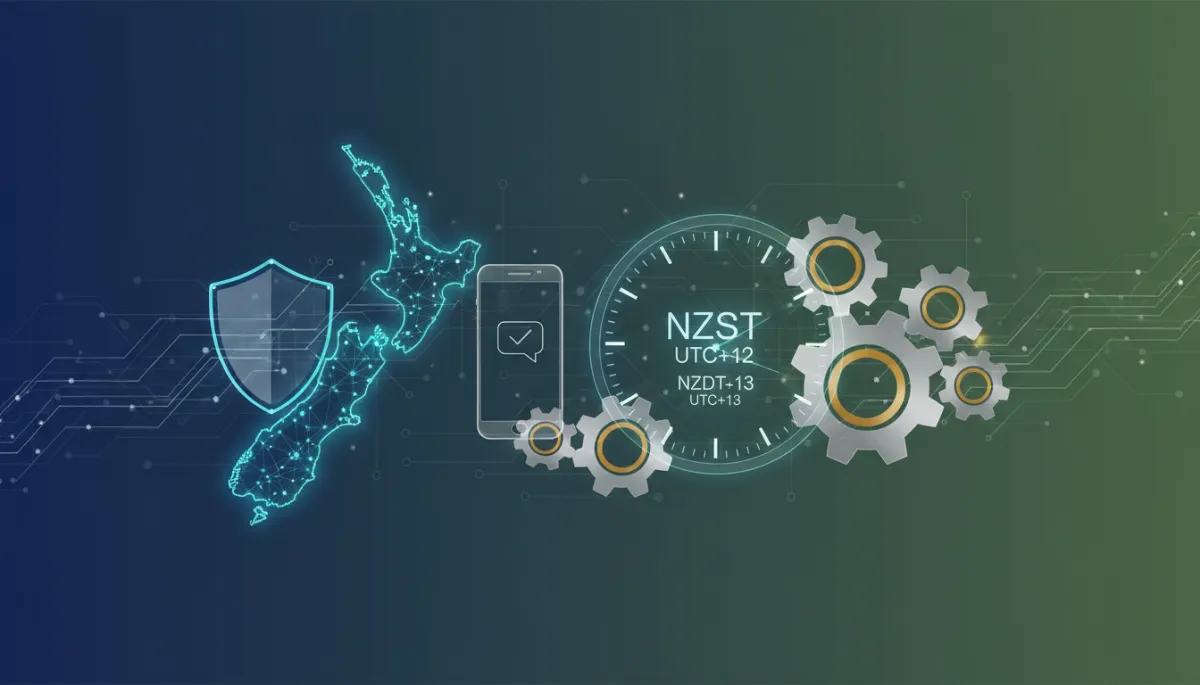
GoHighLevel for New Zealand Businesses: How to Build a CRM That Handles Privacy, SMS Compliance, and Local Timezones
CRM, GoHighLevel, New Zealand Compliance
Most GoHighLevel snapshots, YouTube tutorials, and “plug-and-play” templates are written for the US market. When those builds are dropped into a New Zealand business, they usually ignore New Zealand consent rules, local SMS provisioning, and NZST/NZDT scheduling, even when the rest of the funnel looks polished on the surface.
This post walks through how to configure GoHighLevel so it aligns with the Privacy Act 2020, the Unsolicited Electronic Messages Act 2007, and New Zealand timezones, including the NZST and NZDT daylight saving shift. We will look at consent capture, SMS sender setup with New Zealand telcos, and sending windows that respect local hours.
You will also see how to build local pipelines and multi-location workflows for Auckland, Wellington, and Christchurch, so your CRM reflects how New Zealand businesses actually sell and operate. The aim is a GoHighLevel account that works with New Zealand law and buyer behaviour, not against it.
Why generic GoHighLevel setups fail in New Zealand
Most off-the-shelf GoHighLevel builds were designed around CAN-SPAM style email rules and lighter-touch SMS regimes. New Zealand’s Unsolicited Electronic Messages Act 2007 (UEMA 2007) is stricter on prior consent, and that difference shows up immediately in how forms and funnels are wired. A template that “works fine” in the US can put a New Zealand sender at risk on day one.
The first failure point is consent capture. Many US snapshots rely on passive consent, pre-ticked boxes, or general “by providing your details you agree” language. Under UEMA 2007, you need express or clearly inferred consent before sending commercial SMS, and the Department of Internal Affairs expects that consent to be demonstrable and specific to the channel and purpose, not buried or assumed.
The second failure point is SMS provisioning. Generic setups often assume US-style long codes and carrier relationships. In practice, you need sender IDs and numbers that route cleanly through New Zealand telcos, with clear sender identification in every message. If the originating number or ID looks inconsistent or foreign, deliverability, trust, and compliance all suffer, even if the workflow logic is sound.
The third failure point is workflow timing. Many imported snapshots keep their default timezone, so appointment reminders and nurture sequences are effectively running on US time. That translates into texts and emails landing at the wrong hour for New Zealand recipients, especially once NZDT applies and the offset shifts again. A proper NZ-first configuration treats consent, sender provisioning, and timezone logic as core design decisions, not afterthoughts to patch later.
The Privacy Act 2020 checklist most implementers miss
The Privacy Act 2020 replaced the 1993 Act and is built around 13 Information Privacy Principles (IPPs). In a CRM like GoHighLevel, several principles are particularly relevant: IPP 1 (purpose of collection), IPP 3 (notification at collection), IPP 5 (storage and security), IPP 6 (access), IPP 8 (accuracy), and IPP 11 (limits on disclosure). The Office of the Privacy Commissioner at privacy.org.nz provides the authoritative guidance and should anchor your internal policies.
IPP 1 and IPP 3 mean you need to be clear about why you are collecting personal information, and you must tell people that at the point of collection. In GoHighLevel, that translates into form designs where the purpose of collection is stated in plain language next to the fields, not hidden in a distant privacy policy link. If you plan to use data for marketing, remarketing, or SMS reminders, that needs to be explicit up front.
Consent on GoHighLevel forms should be captured with an unticked checkbox, clear wording about what the person is agreeing to, and a short note on retention. For example, you might state that contact details will be used for service updates and offers, retained for a defined period, and can be corrected or deleted on request. This supports IPP 6 and IPP 8 by signalling access and accuracy rights from the start, rather than discovering them only when someone complains.
Inside GoHighLevel, there are five settings that most implementers overlook when aligning with the Privacy Act 2020. First, form consent language: every lead form, survey, and booking form should use consistent, NZ-specific wording that reflects your actual purposes. Second, the email footer: sender identification and contact details need to be accurate and match what you have told people at collection, reinforcing IPP 3 and IPP 11 obligations around who holds their data and where to reach you.
Third, SMS opt-out handling should mirror email opt-out, so that a contact’s preferences are respected across channels. Fourth, you need documented data retention policies, and those policies should be reflected in GoHighLevel through workflows or periodic reviews that archive or delete stale records. Fifth, you should have a contact deletion workflow for when individuals exercise their rights to access and correction, ensuring that when you delete on request, the change runs through all active pipelines and automations, not just the main contact list.
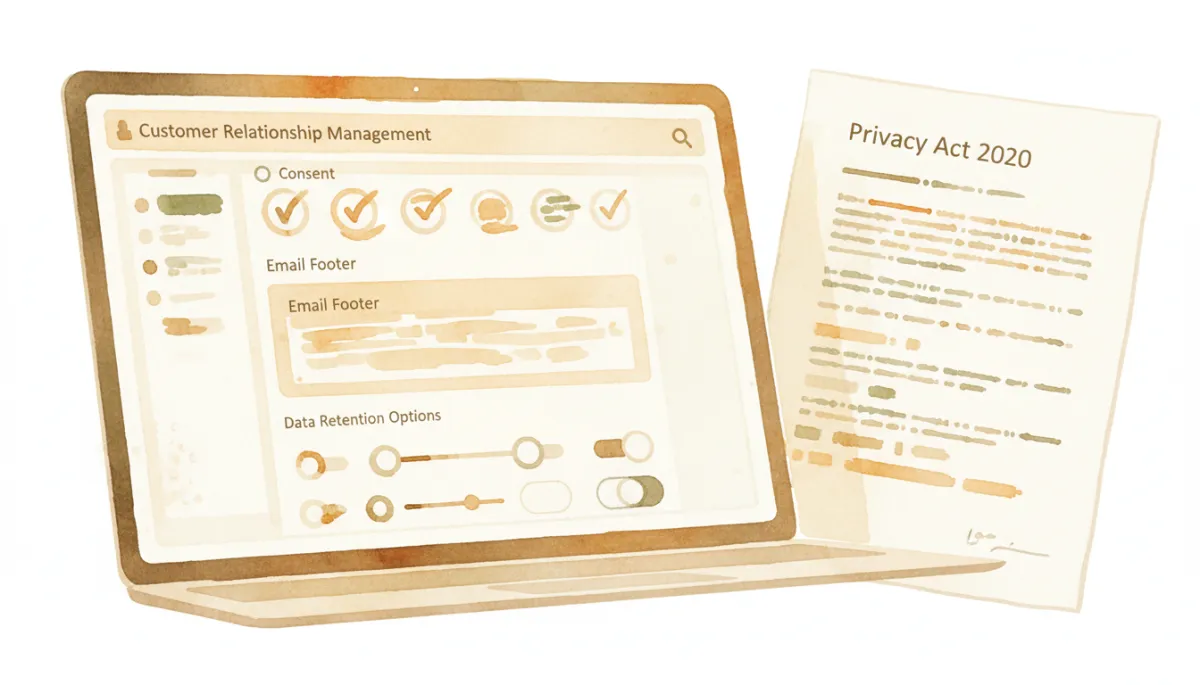
Close-up of a laptop screen showing a CRM settings page with consent checkboxes, email footer...
Aligning consent language and retention rules in the CRM reduces downstream privacy risk.
UEMA 2007 and SMS compliance under GoHighLevel
The Unsolicited Electronic Messages Act 2007 (UEMA 2007) governs commercial electronic messages in New Zealand, including SMS. It requires consent before sending, clear sender identification, and a functional unsubscribe in every message. The Department of Internal Affairs (dia.govt.nz) enforces the Act and has powers to investigate, issue warnings, and pursue penalties where businesses fall short.
Under UEMA, consent can be express, inferred, or deemed, but for CRM-driven SMS marketing it is safer to operate on express consent. This is stricter than regimes like CAN-SPAM, which allow sending until someone unsubscribes. In New Zealand, you should assume that prior consent is required for promotional SMS, and that you need to be able to show when and how that consent was captured if the DIA asks for evidence.
In GoHighLevel, the first configuration step is SMS consent capture at the point of contact acquisition. Every form that can trigger SMS should include a separate SMS consent checkbox, clearly stating that the person agrees to receive text messages, what type, and how often they can expect them. That consent needs to map to a field or tag in the contact record so workflows only send SMS where the flag is present, not just where a phone number exists.
Second, you must configure an appropriate New Zealand sender ID through your SMS provider, so messages show a consistent, legitimate origin. Third, set up unsubscribe keyword handling, usually via STOP and similar terms, and test that these are processed correctly. Fourth, make sure opt-outs are reflected across both email and SMS in the same contact record, so a person who unsubscribes from one channel is not hammered on another in a way that looks like you are ignoring their choice.
Fifth, implement sending window restrictions so you do not text between 9pm and 9am New Zealand time, even if GoHighLevel technically allows it. This is partly about UEMA expectations and partly about basic good practice; after-hours messages are more likely to trigger complaints and DIA attention. Getting this wrong carries practical costs: formal complaints, potential fines, and damage to trust that is hard to repair once customers feel spammed or disrespected.
NZST, NZDT, and the timezone traps that break automations
New Zealand operates on NZST (UTC+12) for part of the year, shifting to NZDT (UTC+13) from late September to early April for daylight saving. Many GoHighLevel accounts are set once at the account level and then left alone, on the assumption that this takes care of timing. In practice, that assumption is where most automation timing issues begin, especially for appointment-heavy businesses.
GoHighLevel has separate timezone settings for the main account, each sub-account, individual calendars, and sometimes individual workflows. If you change only the global setting, you can still have calendars firing confirmation and reminder messages on the wrong offset. That shows up as reminders going out an hour early or late around the daylight saving changeover, which is exactly when clinics, trades, and agencies are already stretched managing the seasonal workload shift.
The two moments that break most New Zealand GoHighLevel accounts are the DST transitions in late September and early April. If your workflows use absolute times without considering the change, a 9am reminder can become an 8am or 10am reminder overnight. That is annoying for marketing campaigns and material for appointment-based services, where missed appointments and confusion turn directly into lost revenue and support load.
For businesses serving Australian clients as well, there is another layer. AEST is two hours behind NZST, but AEDT and NZDT start and end on different dates, so the offset shifts during the year. If you run cross-Tasman campaigns from one GoHighLevel account, you cannot rely on “same time in both countries” logic; you need explicit handling of which timezone each contact or calendar belongs to, especially around launch windows and reminders.
A practical fix is to configure workflow wait steps using specific hour offsets and clearly labelled timezone assumptions, rather than relying solely on GoHighLevel’s automatic timezone detection. For example, you might wait a defined number of hours after a trigger, then send at a set local time based on the calendar’s timezone, checking that each calendar is correctly set to NZST/NZDT. That reduces surprises at the two DST transition points and keeps reminders aligned with real-world expectations.
Building local pipelines that fit New Zealand sales cycles
New Zealand B2B sales cycles usually run longer than their US equivalents. Markets are smaller, referral networks matter more, and buyers often want a higher trust threshold before committing. If you drop in an aggressive, short-cycle pipeline from a US template, it will usually overestimate how quickly New Zealand prospects move from first contact to signed agreement, and underestimate the number of conversations required along the way.
Pipeline stages that fit New Zealand conditions often include steps that rarely appear in default GoHighLevel templates. Stages like “Referred introduction”, “Warm follow-up”, “Reference check requested”, and “Trial or pilot period” reflect how decisions are actually made here. They recognise that a buyer might want to talk to an existing client, run a small pilot, or involve multiple stakeholders before moving to a formal proposal or contract stage, rather than leaping from demo to close in a week.
Segmentation should also differ by industry. Professional services might need stages around scoping workshops and engagement letters, while trades benefit from stages covering quote issued, site visit booked, and council or consent steps. Healthcare often requires stages for referral received, initial consultation, treatment plan agreed, and follow-up review, with tighter controls on who can see which records. A single generic pipeline for “all industries” tends to become cluttered and ignored once the team realises it does not match their reality.
Follow-up cadence is another point where imported sequences misfire. New Zealand buyers generally respond poorly to daily or near-daily sequences that are common in US marketing playbooks. A better fit is fewer touches per week, more personalised content, and sequences that leave space for people to think, consult colleagues, or check budgets, without feeling like they are being chased. This also reduces unsubscribe rates and keeps your brand in the “useful” category rather than “pushy”.
When you build pipelines in GoHighLevel around New Zealand sales cycles, the test is simple: each stage and automation should map to a real step your team already takes. Pipeline logic is at its strongest when it mirrors how the business actually sells, rather than forcing the team to adopt a foreign sales rhythm that does not fit their market.
Multi-location workflows for Auckland, Wellington, and Christchurch businesses
Auckland is New Zealand’s largest commercial market, with higher lead volumes and faster response expectations, especially in agencies and professional services. In GoHighLevel, that means building workflows that prioritise speed of response: instant lead alerts, round-robin assignment, and missed-call text-back as standard, not optional. Auckland agencies and professional service firms can explore our GoHighLevel Expert Auckland implementation support. Multi-location setups should route Auckland leads to local teams and calendars, with SLAs and automation tuned for quick follow-up and clear handoffs between sales and delivery.
Wellington has a different profile: professional services, consulting, and government-adjacent sectors dominate, and buyers are more likely to ask detailed questions about data handling on the first call. Workflows there should emphasise consent capture rigour, clear documentation of where data is stored, and easy access to records if an audit or privacy request arrives. Wellington businesses needing compliant CRM migration and automation can visit our GoHighLevel Expert Wellington page. In practice, that often means additional consent stages, internal notes, and template responses that reference the Privacy Act 2020 and link to your privacy policy in a way that stands up to scrutiny.
Christchurch and the wider Canterbury region are seeing growth across trades, property, and health, with a different pacing to the North Island. Sales cycles often rely more heavily on relationships, repeat work, and local reputation, with longer gaps between first enquiry and final decision. Workflows in GoHighLevel should reflect that by using slower follow-up cadences, more personal touchpoints, and stages that capture site visits, quotes, and seasonal work patterns. For businesses scaling in Canterbury, see our GoHighLevel Expert Christchurch service page. A well-structured multi-location setup gives each city its own cadence, messaging, and pipeline logic, while still rolling up to a single, coherent reporting view.
What proper NZ-first implementation looks like
A proper NZ-first GoHighLevel implementation weaves New Zealand-specific requirements into every phase, rather than bolting them on at the end. In the audit phase, you identify which regulations apply to your business: the Privacy Act 2020 always, UEMA 2007 whenever SMS or other commercial electronic messages are in play, and any sector-specific rules for areas like healthcare or financial services. That audit should also map your current consent mechanisms, data flows, and timezone behaviour across locations.
In the build phase, you configure the five key Privacy Act settings, wire in UEMA-compliant SMS consent and unsubscribe handling, and set up NZST/NZDT-aware workflows and calendars. This is where you define pipelines that reflect New Zealand sales cycles, create city-specific workflows, and document how consent, retention, and deletion are handled in practice. The goal is a system where compliance is achieved through design, not through manual workarounds by individual staff members.
The connect phase focuses on integrations: connecting GoHighLevel to other tools in a way that respects New Zealand data sovereignty considerations and your own data residency commitments. That might mean being deliberate about which external services hold customer data and how information is synchronised, rather than turning on every available integration by default. Finally, the deploy phase is about training the team on ongoing compliance, not just the mechanics of using the CRM, so they understand why certain fields, checkboxes, and stages exist and how to handle access or deletion requests confidently.
Done properly, this approach gives you a GoHighLevel account that supports growth while reducing regulatory risk and operational friction, instead of adding another system you constantly have to work around.
Frequently asked questions
Does GoHighLevel comply with New Zealand's Privacy Act 2020?
GoHighLevel is a flexible platform, not a pre-certified compliance solution. It can be configured to support Privacy Act 2020 obligations, especially around purpose, notification, access, accuracy, and disclosure, but that depends on how you design forms, consent flows, retention rules, and deletion processes. Alignment with the Act is achieved through your implementation choices, not by default.
Is GoHighLevel legal for SMS marketing in New Zealand under UEMA 2007?
Yes, you can use GoHighLevel for SMS marketing in New Zealand, provided you meet UEMA 2007 requirements. That means capturing valid consent before sending, including clear sender identification in each message, and providing a functional unsubscribe that is honoured promptly. The Department of Internal Affairs focuses on your behaviour and configuration, not the specific CRM brand you use.
How do I set up NZST or NZDT correctly in GoHighLevel?
Start by setting the main account timezone to the correct New Zealand zone, then repeat that check for each sub-account, calendar, and key workflow. Test appointment reminders and time-based automations across the daylight saving transitions. Where possible, use relative waits and clearly labelled local-time send steps, rather than assuming a single global setting covers everything.
Can GoHighLevel handle multi-location businesses across Auckland, Wellington, and Christchurch?
Yes, GoHighLevel can support multi-location setups across New Zealand cities. The key is to separate pipelines, calendars, and workflows by location, while keeping shared assets like templates and reporting consistent. You can route leads based on city, assign them to local teams, and tune follow-up cadence and messaging to match each region’s sales rhythm and compliance profile.
What is the difference between GoHighLevel setup in New Zealand versus Australia?
The platform is the same, but regulatory, timezone, and buyer behaviour details differ. In New Zealand, you are working with the Privacy Act 2020, UEMA 2007, NZST/NZDT, and generally longer, more relationship-driven sales cycles. Australian implementations face their own legal and timezone nuances, so copying an Australian snapshot into a New Zealand account without adjustment is risky.
Do I need an implementation partner for a New Zealand GoHighLevel setup?
You can configure GoHighLevel yourself if you are comfortable interpreting New Zealand privacy and messaging requirements and translating them into workflows. Many businesses, though, prefer to work with an implementation partner who understands local law, industry norms, and multi-location design. That reduces rework, speeds up deployment, and lowers the risk of missing a critical compliance detail.
How much does GoHighLevel cost in New Zealand?
GoHighLevel charges in USD globally, so New Zealand businesses pay the same base rates, converted at current exchange rates. Starter is US$97/month (around NZ$160), Unlimited is US$297/month (around NZ$490), and SaaS Pro is US$497/month (around NZ$820). Actual NZD amounts vary with the exchange rate and any additional usage or payment provider fees.
What to do next
First, run a structured audit of your current GoHighLevel account against the Privacy Act 2020 and UEMA 2007 points outlined here, including consent capture, unsubscribe handling, and deletion workflows. Second, book a strategy call to work through NZ-specific configuration questions, especially if you are running SMS or multi-location operations. Third, review the Auckland, Wellington, or Christchurch pages relevant to your base to align workflows with local market expectations.
If you want a GoHighLevel account that matches New Zealand law, culture, and sales cycles, a focused implementation project now will save considerable time and risk later.
To move quickly, you can book a 30-minute strategy call with HL Growth Partner and speak with Dr Priya Jaganathan, GoHighLevel Certified Admin and 3x HighLevel keynote speaker, about your current setup and priorities. The session focuses on your existing account, risks, and practical next steps rather than generic demos.
Related Articles
Go High Level
- 7 CRM Automation Mistakes New Zealand Businesses Make When Setting Up GoHighLevel
- Best CRM for New Zealand Businesses 2026 | GoHighLevel
- GoHighLevel for Mortgage Brokers: The Compliance-Ready CRM Build (2026)
GHL Funnels & CRM
- GoHighLevel Pipelines & Opportunities: CRM Setup (2026)
- GoHighLevel Chat Widget: Setup, SMS Chat & Live Chat (2026)
- GoHighLevel Tags vs Custom Fields: When to Use Which to Keep Your CRM Clean (2026)
