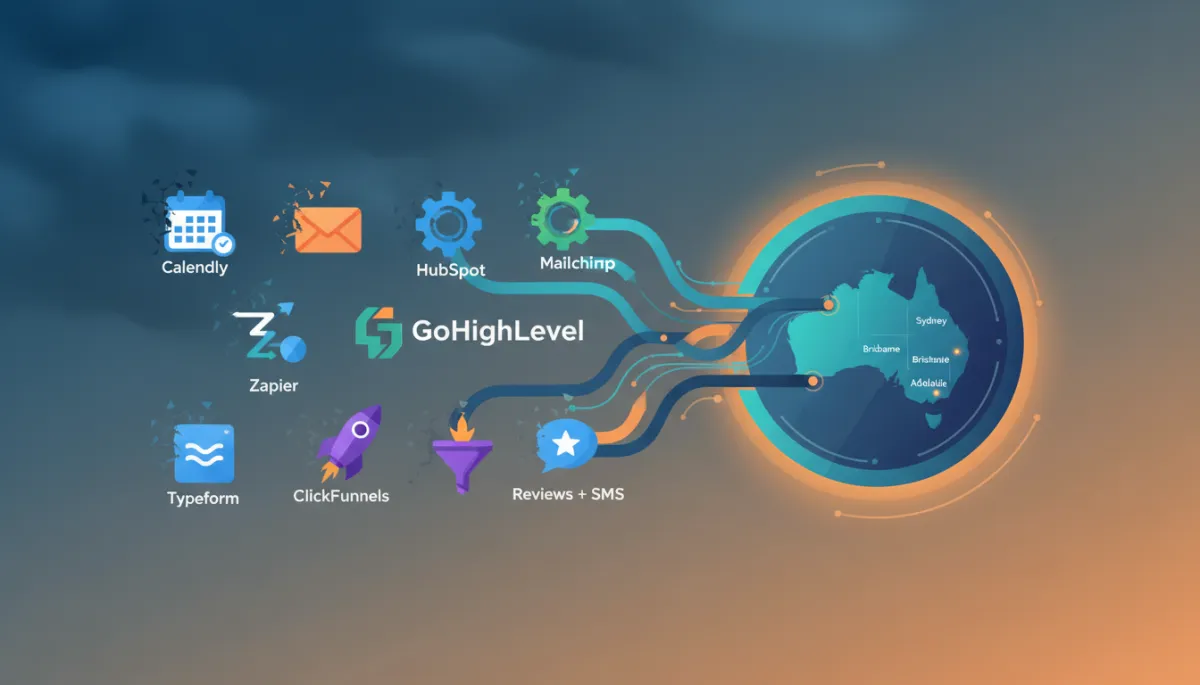
Why Australian Businesses Are Replacing Calendly, Mailchimp, HubSpot, Zapier and Other Tools with GoHighLevel in 2026
GoHighLevel Australia, Tool Consolidation, CRM, Marketing Automation
If you run a small or mid-sized business in Australia, your software stack probably looks like this: a calendar tool for bookings, Mailchimp for email, HubSpot or something similar for CRM, Zapier to glue it together, a funnel builder for landing pages, a form tool, plus a reviews and SMS platform on the side. Six to eight logins, none of them quite talking properly. And every few weeks, a Zap breaks quietly overnight. In 2026, with costs climbing and margins under pressure, more owners in Sydney, Melbourne and beyond are finally sitting down to audit that stack. They are realising they are paying premium subscription prices, usually in US dollars, for tools that often create more manual work, not less. This article walks through what GoHighLevel actually replaces, what it really saves compared with your current setup, and the honest catch you need to know before you even think about switching.
Tool What it does Cost (USD/mo) Approx AUD/mo GHL replaces it? Calendly (Standard) Online booking and scheduling ~US$12 ~A$18 ✅ Mailchimp (Standard) Email marketing and basic automation ~US$20 ~A$30 ✅ HubSpot (Starter) CRM, basic sales and marketing tools ~US$20 ~A$30 ✅ Zapier (Professional) Automations between apps ~US$30 ~A$45 ✅ ClickFunnels (Startup) Funnels and landing pages ~US$97 ~A$146 ✅ Typeform (forms/surveys) Forms, quizzes and surveys ~US$29 ~A$44 ✅ Reviews + SMS tool Reputation management and text messaging ~US$40 ~A$60 ✅ STACKED TOTAL Disconnected tool stack ~US$248 ~A$373 — GoHighLevel (Starter) All-in-one CRM, marketing and automations ~US$97 ~A$146 Replaces all above
That table uses conservative entry-level plans. It is the floor, not the real number. As you grow, Mailchimp alone can climb to roughly US$90–135 per month at 5,000–10,000 contacts, and meaningful HubSpot automation sits behind Professional at around US$890 per month, plus an onboarding fee of about US$3,000. So a growing Australian business is really comparing something in the US$1,100–1,300+ per month range against GoHighLevel at roughly US$97–297 per month, based on current 2026 list pricing.
There is an honest catch with GoHighLevel: SMS, email and phone usage are billed on top through your platform wallet. In practice, most Australian businesses land somewhere between about US$20 and US$150 per month in usage, depending on send volume. Even at the high end, you are looking at roughly US$250 per month all-in versus a US$1,000+ disconnected stack. The saving is real; we are just not going to pretend the usage fees do not exist.
What GoHighLevel Actually Replaces
Replacing Calendly: Bookings Tied Directly to Your CRM
Right now, you might be paying around US$12 per user each month for Calendly Standard. It handles bookings well: clean links, reminders, basic routing. The problem is what happens after the booking. The contact lands in Calendly, then has to be pushed into your CRM through Zapier or a native integration. If a zap fails or an integration token expires, you get no-show leads and manual spreadsheet work to fix the mess. For a team with multiple calendars, this gets messy fast, especially when staff change roles or leave the business.
GoHighLevel gives you native calendars, booking links and round-robin scheduling directly inside the CRM. When someone books, they are created or updated as a contact, added to the right pipeline stage, and dropped into an automated follow-up sequence. Reminders go out by email and SMS from the same place. Reschedules and cancellations are tracked against the same contact record. You can see the entire journey from first click to booked call without touching Zapier at all. For teams that live in their calendars, this alone can justify looking at an all-in-one CRM for Australia-based businesses.
The honest catch: Calendly is still the gold standard for pure scheduling UX. It feels lighter and more polished, especially on mobile. If you are a solo consultant who only needs beautiful booking links and nothing else, Calendly may still be the nicer experience. GoHighLevel wins when bookings are one piece of a bigger system, not a standalone tool. If you are replacing Calendly, Mailchimp and Zapier together, the minor UX downgrade is usually worth the trade for a single source of truth.
Replacing Mailchimp: Email and SMS Without Per-Contact Price Gouging
Mailchimp starts cheap. Standard is roughly US$20 per month at 500 contacts. But as independent pricing reviews show, by 5,000–10,000 contacts you are closer to US$100–135 per month for Standard, and more again for Premium. Mailchimp also counts unsubscribed and “non-marketing” contacts towards your bill unless you archive them, which many teams forget to do. That “contact bloat” is why so many Australian businesses get a surprise bill when a list grows after a good campaign or a busy season.
GoHighLevel flips the model. You get unlimited contacts on every plan. You pay a flat platform fee, then a tiny usage fee for email and SMS sends. For a Melbourne ecommerce brand running weekly campaigns and abandoned-cart flows, this can be a big shift. Instead of trimming your list to dodge a higher Mailchimp tier, you can keep every customer and prospect inside one all-in-one CRM for Australia, then segment them with tags and smart lists. You also add SMS into the same workflows, instead of bolting on a separate texting tool. If you are comparing GoHighLevel vs HubSpot or Mailchimp on pure send cost, the usage-based model often wins once your list is past a few thousand contacts.
The catch: Mailchimp’s email builder is still one of the most polished in the market, with deep template libraries and advanced reporting for email-only teams. If all you need is a beautiful newsletter tool and nothing else, Mailchimp is excellent. GoHighLevel’s builder is good, but the real value is how email, SMS, funnels and CRM all sit in one place. For a growing Melbourne-based business looking to consolidate tools, that trade-off is usually worth it.
Replacing HubSpot: Full CRM and Pipelines at a Fraction of the Cost
HubSpot is powerful and, for many mid-market teams, the default choice. The free tier gives you basic CRM. Starter bundles begin around US$7–20 per seat per month, but serious automation, custom reporting and multi-pipeline setups live in Professional and Enterprise. By the time you add enough seats and marketing contacts, it is not unusual to see invoices around US$1,300 per month or more, plus onboarding costs. For a Sydney agency or consultancy, that is a serious commitment, especially when not every feature gets used day to day.
GoHighLevel gives you a full CRM, deal pipelines, tasks, notes, quotes, proposals, and reporting on every plan. You get one central contact record with every call, text, email, form fill, funnel visit and invoice attached. For a Sydney digital agency wanting to streamline client management, that means you can see exactly which campaign drove each lead, how many touchpoints it took to close them, and what their lifetime value looks like, without stitching data together from three tools. You also avoid HubSpot’s seat-based pricing; GoHighLevel allows unlimited users per account, which matters once you involve sales, service and admin staff in the system.
The honest catch: HubSpot still wins on enterprise depth. Its reporting, ecosystem and native integrations are broader. If you are a large, complex organisation with multiple business units and a dedicated RevOps team, HubSpot’s advanced features can justify the spend. GoHighLevel is a better fit for small to mid-sized Australian businesses that need serious automation and CRM power, but do not need to pay for a full enterprise marketing cloud. When you compare GoHighLevel vs HubSpot purely on cost-to-value for this segment, GoHighLevel usually comes out ahead.
Replacing Zapier: Built-In Automations Without Per-Task Billing
Zapier is the silent line item in many stacks. Professional plans sit around US$30 per month, but the real cost is task volume. Every time a lead submits a form, books a call, or triggers a tag, that is another task. As your list and lead flow grow, you move up Zapier tiers or start turning off zaps to control spend. When a zap breaks, nobody knows until a lead complains or someone spots a gap in a spreadsheet. For a Brisbane trades business or local service, this is often where leads quietly go missing between tools.
GoHighLevel bakes automation into the platform. Workflows are built around triggers like form fills, pipeline stage changes, bookings, SMS replies and more. You can branch logic, add delays, send emails and texts, assign tasks, update fields, and move deals between stages, all without leaving the system or paying per task. Many of the zaps you rely on today simply disappear because the tools are now native. A Brisbane-based business wanting to simplify its automations can often collapse dozens of zaps into a handful of GoHighLevel workflows in a weekend.
The catch: Zapier’s app library is enormous. If you rely on niche tools or deep two-way syncs with platforms GoHighLevel does not yet support natively, you may still keep a small Zapier plan in the background. GoHighLevel covers most mainstream use cases, but it is not a one-to-one replacement for Zapier’s entire ecosystem. For many Australian businesses, though, it replaces enough of those “glue” automations that the Zapier bill can be downgraded or removed entirely.
Replacing Funnel and Landing-Page Builders: Native Funnels and Sites
Tools like ClickFunnels and Leadpages are built to do one thing well: capture leads and sales through funnels and landing pages. ClickFunnels’ entry plan sits around US$97 per month. If you are running multiple offers, webinars and upsell flows, that feels like a fair trade… until you add it on top of your CRM, email platform, booking tool and Zapier. You end up with forms and payments living in one system, while your actual customer records live somewhere else, joined by fragile integrations and webhooks.
GoHighLevel includes a drag-and-drop funnel and website builder on every plan. You can spin up landing pages, sales pages, checkouts and full websites that connect directly to your CRM and automations. For a Perth business wanting to refresh its funnels, the move often looks like this: rebuild your top-performing funnel inside GoHighLevel, connect payments, then map the form submissions straight into your pipeline with automatic follow-up. No more exporting leads from ClickFunnels or relying on a zap to push data across. Over time, you can replace your old site or at least key landing pages to simplify tracking and hosting costs.
The catch: if you are a hardcore funnel specialist who lives inside ClickFunnels every day and uses advanced templates, split-testing features and third-party add-ons, you may miss some of that depth. GoHighLevel’s builder is strong and improving fast, but it is designed to be part of an all-in-one CRM Australia can rely on, not a standalone funnel empire. For most small and mid-sized businesses, the integrated approach is more than enough, and it removes another US$97+ from the monthly stack.
Replacing Forms and Surveys: Built-In Capture That Feeds the CRM
Tools like Typeform and Jotform charge around US$29 per month and up for forms, quizzes and surveys. They are great at what they do: clean forms, logic jumps, nice completion experiences. But again, the data lands in yet another system. You then push it into your CRM or email tool through native integrations or Zapier, and hope it all stays in sync. For simple contact forms, event registrations and feedback surveys, this is overkill and adds another login to your already crowded browser bar.
GoHighLevel includes a forms and surveys builder that connects directly to contacts, opportunities and workflows. Every submission becomes (or updates) a contact, can create a deal, and can trigger follow-up sequences. You can embed these forms on GoHighLevel pages, your existing website, or even share them as standalone links. Because everything sits in one database, you can report on form performance, segment contacts by survey responses, and trigger nurture sequences without leaving the platform. This is where the “replace Calendly Mailchimp Zapier” idea becomes real: one form can book a call, tag a contact, start a sequence and update a pipeline, all natively.
The catch: Typeform-style experiences with very slick one-question-at-a-time flows and heavy design customisation are still nicer in the dedicated tools. If your brand lives or dies on ultra-polished survey UX, you may keep a small Typeform plan for flagship campaigns. For everyday lead capture, GoHighLevel’s forms are usually more than enough, and the benefit of having the data land cleanly in your CRM outweighs the design difference.
Replacing Reviews and SMS Tools: Reputation and Messaging in One Place
Many Australian businesses now pay for a dedicated reviews platform plus a separate SMS tool. That might be around US$40 per month for reviews and US$40–60 for SMS, depending on volume and features. These tools help you request Google reviews, send reminders, and handle basic two-way texting. But again, they are disconnected from your main CRM. Reviews live in one dashboard, conversations in another, and your sales team in a third. Nobody has a full view of the customer’s history when they pick up the phone or reply to a message.
GoHighLevel brings reputation management and two-way SMS into the core platform. You can send automated review requests after appointments, track which contacts have left a review, and see those reviews against the contact record. SMS conversations live in a shared inbox, so your team can see who said what and when. You can also trigger campaigns based on review status or conversation outcomes. For local service businesses, this is often where the real revenue uplift comes from: faster responses, more reviews, and better follow-up on hot leads, all inside one GoHighLevel alternative to your current stack.
The catch: if you rely on very advanced review syndication, niche directory integrations or deep reporting across dozens of locations, some dedicated reputation platforms still have more bells and whistles. GoHighLevel covers the 80% that matters for most small and mid-sized Australian businesses: asking for reviews at the right time, tracking them, and using SMS to drive real conversations and bookings.

Consolidating tools into GoHighLevel gives Australian teams one clear view of every customer.
Why Australian Businesses Specifically — in 2026
Most of the tools we have talked about bill in US dollars. When the Australian dollar softens, your SaaS costs rise overnight, even if you do not add a single contact or user. Many owners only notice when their accountant flags the jump at EOFY. GoHighLevel still bills in USD too, but the difference is you are consolidating five to eight tools into one bill. You are exposed to the exchange rate once, not across a whole grid of subscriptions. In a year where cash flow is tight and interest rates are high, that matters more than it did in 2020 or 2021.
There is also the tax side. Some overseas SaaS vendors still make GST handling painful or inconsistent. Invoices land without clear GST treatment or ABN details, which makes your bookkeeper’s job harder. When you centralise more of your stack into a single platform, you simplify how you track and code those costs. It is not glamorous, but it saves time every quarter and reduces the back-and-forth between your team and your accountant at BAS time. For multi-location businesses, that admin load can be significant across a year.
Local realities also matter. Australian SMS sender rules, number provisioning, and compliance requirements are tightening. Getting this wrong can mean blocked messages or fines. GoHighLevel works with providers that understand local regulations and number registration processes, so you are not trying to hack together cheap overseas SMS gateways that may or may not deliver reliably. Time zones and support windows also play a role; having local specialists who know both the platform and Australian conditions is becoming a quiet competitive advantage in 2026, especially as AI-driven tools and agentic automations accelerate. In short, Australian businesses are consolidating not just for cost, but for control and compliance in a shifting SaaS landscape.
It Is Not Just Cost — It Is One Source of Truth
Saving a few hundred dollars a month is nice. The bigger shift, though, is strategic. When you run Calendly, Mailchimp, HubSpot, Zapier, ClickFunnels and a reviews tool side by side, you never really have a single, clean customer record. A lead might exist in three or four systems under slightly different names or email addresses. Attribution is guesswork. Your team spends hours each week exporting CSVs, cleaning data and trying to work out which campaign actually drove revenue. Leads fall through the cracks when a zap fails or an integration is not updated after a tool changes its API.
With GoHighLevel Australia, everything points to one contact record. Every form fill, page visit, booking, call, text, email, invoice and review attaches to that record. Pipelines show you exactly where each opportunity sits and what has happened so far. When marketing wants to know which ads produce the highest-value customers, the data is there. When sales wants to see which leads are ready for a call, they can filter by engagement across channels, not just email opens. Even if your cost saving is modest because you are on lower tiers today, the operational benefit of one source of truth is what justifies the move. It is the difference between running your business on stitched-together tools and running it on a single, coherent system.
How Hard Is It Actually to Switch?
What you are moving Difficulty What actually happens Contacts and lists Easy Export CSVs from Mailchimp/HubSpot, import into GoHighLevel; a few hours of cleaning and mapping fields. Calendar / booking Easy Rebuild booking links, connect your calendars, map availability and buffer times; swap links on your website and emails. Email templates Moderate No direct import; copy content and rebuild key templates in the GoHighLevel editor, then test across devices. Funnels / landing pages Moderate Rebuilt, not migrated; often an upgrade in structure and tracking, but takes design time to match offers and branding. HubSpot/Mailchimp automations Involved Logic is rebuilt natively; mapping triggers, conditions and actions is the real work and needs careful planning. Zapier workflows Involved Most collapse into native GoHighLevel automations; each needs reviewing so nothing critical is lost.
The reality is this: data moves in an afternoon. Contacts, basic fields, even simple lists are straightforward. The hard part is the logic. Rebuilding HubSpot workflows and Zapier zaps natively inside GoHighLevel is where most DIY migrations stall. It is also where a local specialist, whether you are in Melbourne, Sydney or working with a Brisbane-based GoHighLevel consultant, earns their fee. They have already made the mistakes on someone else’s account and can help you avoid breaking revenue-critical journeys during the switch.
The Honest Catch — When NOT to Switch
GoHighLevel is not magic. There is a learning curve. The interface is broad because it covers calendars, funnels, CRM, messaging, automations and more. If you or your team are already overwhelmed by software, dropping a powerful all-in-one CRM on top without a plan will not fix that. Migration also takes time. If you are in peak season or going through a major internal change, it may be smarter to stabilise first, then switch when you can give the project proper attention or budget for expert help.
You should also think twice about switching if you only use one tool and genuinely love it. If you live in Calendly, send a simple monthly newsletter from Mailchimp, and do everything else manually, GoHighLevel may be overkill right now. The platform shines when you are replacing a stack, not when you are adding yet another tool. The honest truth is that most people who should switch do not have the time or headspace to manage the migration themselves. That is why the most successful moves we see are guided: clear scope, clear timelines, and a local specialist who can carry the technical load while you keep running the business.
Switch Without the Migraine
The real barrier is not the subscription fee. It is the fear of breaking what is already working “well enough”. That is reasonable. Your current stack may be clunky and expensive, but it is familiar. Switching to GoHighLevel Australia is easier when you are not doing it alone. A good consultant will map your existing tools, design a phased migration, and rebuild your key funnels, automations and pipelines so there is no gap in lead flow or revenue. You get the benefit of consolidation without the headache of figuring it all out from scratch after hours and on weekends.
If you are ready to explore consolidating your tools, start by finding a GoHighLevel expert in your city:
Talk to a GoHighLevel expert in Brisbane if you are a local service or trade with heavy inbound calls and SMS.
Work with a GoHighLevel consultant in Adelaide if you are juggling multiple tools across professional services or healthcare.
Connect with a GoHighLevel partner in Darwin if you are managing remote teams and regional clients.
Find a GoHighLevel expert on the Gold Coast if you run hospitality, tourism or fitness studios.
Partner with a GoHighLevel specialist in Hobart if you are scaling a local brand across Tasmania.
Work with a GoHighLevel expert in Melbourne if you are growing ecommerce, education or professional services.
Team up with a GoHighLevel consultant in Perth if you are in construction, mining services or B2B.
Engage a GoHighLevel expert in Sydney if you are running an agency, SaaS or multi-location operation.
Connect with a GoHighLevel specialist in Canberra if you work with government, associations or education.
GoHighLevel Australia — Frequently Asked Questions
Is GoHighLevel really cheaper than HubSpot?
For most small and mid-sized Australian businesses, yes. GoHighLevel’s Starter plan sits at around US$97 per month with unlimited users and contacts. HubSpot’s real power lives in Professional and Enterprise bundles, which can reach roughly US$1,300 per month or more once you add enough seats and marketing contacts. When you add the supporting tools — Calendly, Mailchimp, ClickFunnels, Zapier — the gap widens further. You do need to factor in GoHighLevel’s usage fees for SMS, calls and email, but even then, many Australian teams land in the US$120–250 per month range versus four figures on a stacked or HubSpot-centric setup. If you are a true enterprise with complex needs, HubSpot can still be worth the price. For most growing local businesses, GoHighLevel delivers a better cost-to-value ratio.
Can GoHighLevel actually replace Zapier?
In many cases, it can replace most of what you currently use Zapier for. GoHighLevel has a strong native automation engine that handles triggers like form submissions, bookings, pipeline changes, tag updates and message events. You can build branching workflows that send emails and SMS, assign tasks, update fields and move deals — all without paying per task. For a lot of Australian businesses, that removes 80–90% of their Zapier usage. That said, Zapier’s app library is still much bigger. If you rely heavily on niche tools or complex two-way integrations that GoHighLevel does not yet support, you may keep a smaller Zapier plan for those edge cases. The goal is not always to delete Zapier entirely, but to stop using it for things GoHighLevel now handles natively.
Is GoHighLevel good for Australian businesses?
It is well-suited to Australian businesses that are tired of juggling multiple tools and want one system for leads, customers and campaigns. Local factors — US-dollar pricing, GST, SMS regulations, time zones — all make tool consolidation more attractive in 2026. GoHighLevel’s unlimited contacts, native calendars, funnels, pipelines and messaging line up well with how Australian service, trades, ecommerce and professional services businesses actually operate. The key is implementation. A platform this broad needs a clear strategy and sensible defaults. That is where working with a local specialist in Melbourne, Sydney, Brisbane or elsewhere can turn it from “another tool” into the backbone of your operations. On its own, the software is strong. With a proper rollout, it can replace a surprising amount of your current stack.
How hard is it to migrate from Mailchimp or HubSpot to GoHighLevel?
Moving the data is the easy part. Exporting contacts and basic fields from Mailchimp or HubSpot and importing them into GoHighLevel is a few hours of work if your lists are clean. The harder part is rebuilding what happens around that data: your automations, scoring rules, nurture sequences and reporting. HubSpot workflows and Mailchimp journeys do not copy across automatically; they need to be re-thought and rebuilt using GoHighLevel’s triggers and actions. If your current setup is simple, you can absolutely do this yourself with some patience. If you have years of layered automations, this is where a local GoHighLevel Australia consultant earns their keep by mapping what you have, cutting what you no longer need, and rebuilding the rest in a more maintainable way.
Do I need an expert to switch, or can I do it myself?
You can absolutely handle the basics yourself. Exporting and importing contacts, setting up a simple pipeline, rebuilding a handful of key email templates — these are all DIY-friendly with a bit of focus. Where most self-led projects go wrong is the automation layer. Recreating complex HubSpot workflows, Mailchimp journeys and Zapier zaps inside GoHighLevel is fiddly and easy to break. It is also where mistakes can cost you leads and revenue. If your business depends on consistent inbound flow, it is worth at least getting a migration plan from a local specialist. You can find a Brisbane GoHighLevel expert, or work with teams in Sydney, Melbourne or other cities, to handle the heavy lifting while you keep your focus on running the business rather than wrestling with workflows at midnight.
Related Articles
Go High Level
- GoHighLevel vs Mailchimp: Which Is Right for Australian Small Businesses (2026)
- Go High Level vs Multiple Tools: When It’s Time for Agencies to Consolidate
- GoHighLevel vs HubSpot: CRM, Automation and True Cost Compared (2026)
GHL Funnels & CRM
- Connecting GoHighLevel to Calendly: When to Migrate vs Integrate (2026)
- GoHighLevel Proposals & Estimates: Setup (2026)
- GoHighLevel for Med Spas: Booking & Rebooking Snapshot (2026)
