Why GoHighLevel is Key for Aussie Services in 2026
CRM, GoHighLevel Australia, 2026 Business Trends, Australian Service Businesses, agencies
Why Australian Service Businesses Are Replacing Traditional CRMs With GoHighLevel in 2026
The shift isn't about features — it's about the cost of running 7 disconnected tools in a market where ACMA Sender ID rules just changed and software costs are rising 12% a year.
By Dr Priya Jaganathan · GoHighLevel Certified Admin · 3x HighLevel keynote speaker · May 2026 · 9 min read
The CRM problem most Australian service businesses don't realise they have
Six months ago, an Australian agency owner sent me a screenshot of her monthly software bill. HubSpot Professional. Mailchimp. ClickFunnels. Calendly. ManyChat. CallRail. Loom. ActiveCampaign for a legacy client. The total was AUD $4,800 per month — and her team was still spending five hours a week duct-taping the tools together with Zapier.
She isn't unusual. Across the 500+ GoHighLevel builds we've audited, the most common reason Australian service businesses move from traditional CRMs to GoHighLevel isn't a single failing in HubSpot, Salesforce, or Keap. It's the cumulative weight of running 5 to 8 disconnected tools, each demanding its own subscription, its own integration, its own learning curve, and its own compliance configuration.
In 2026, that weight is heavier than it's ever been. SaaS prices have risen 10-15% across most major CRM platforms in the last 18 months. The ACMA SMS Sender ID Register comes into force on 1 July 2026, adding a new compliance layer for any business sending branded text messages. AI features that were experimental in 2024 are now table-stakes — and most legacy CRMs charge enterprise prices to unlock them.
This post breaks down why Australian service businesses are switching, what the consolidation case actually looks like in AUD, and where the migration usually goes wrong. If you're weighing the move yourself, HL Growth Partner's Australian implementation services are built specifically for this transition — but you'll have enough to decide for yourself by the end of this article.
Why traditional CRM stacks are breaking
Traditional CRMs aren't broken — they're misaligned. HubSpot, Salesforce, and ActiveCampaign were designed for the business needs of 2015 to 2020: a CRM here, an email tool there, a separate funnel builder, a separate booking system, all stitched together by an in-house ops team that understands the integrations.
Three things have changed since then:
Australian SMBs no longer have dedicated marketing operations staff. The cost of a full-time ops hire in Sydney or Melbourne now runs above AUD $110,000 loaded. Most service businesses under 50 staff cannot justify it, leaving the agency owner or office manager to glue tools together at 11pm on Tuesdays.
Customer expectations have caught up. A buyer who fills in a form on Monday expects an SMS within minutes, an email follow-up that afternoon, and a booking link that handles their timezone. A 3-tool stack with manual hand-offs can't deliver that consistently.
Compliance has tightened. Spam Act 2003 enforcement has sharpened. The ACMA Sender ID Register adds a new layer from July 2026. The Privacy Act 1988 review is producing concrete reforms. Multi-tool stacks make compliance harder because consent, unsubscribe, and data handling have to be configured separately in every platform.
The result is predictable. The CRM does its job. The email tool does its job. The funnel builder does its job. But the business between them is leaking leads, missing bookings, breaching compliance, and burning the owner's time on coordination.
The rising cost of multiple tools
Here's a comparison for a typical Australian service business — say, a Melbourne consulting firm with 8 staff, 5,000 contacts, and active marketing automation. AUD figures, May 2026:
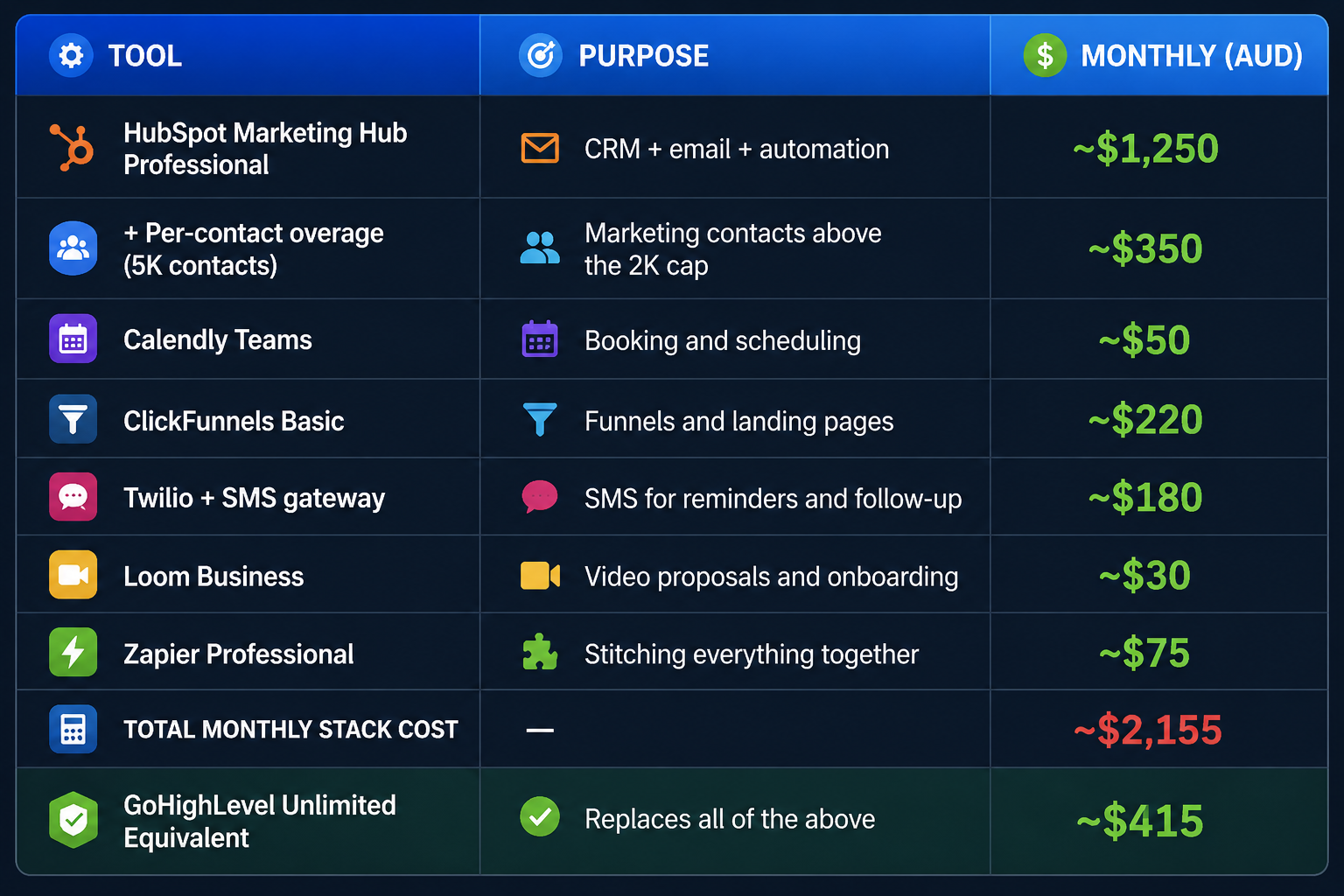
Annualised, the traditional stack costs roughly AUD $25,860. GoHighLevel covers the same operational ground for AUD $4,980. The gap is approximately AUD $20,000 per year — and that's before factoring in the AUD $4,200 one-time HubSpot Professional onboarding fee, or the cost of the time someone spends maintaining the integration layer.
This is the line that ends most of these conversations. See the full GoHighLevel pricing breakdown for Australian businesses for tier-by-tier detail.
Why Australian businesses want all-in-one platforms
Cost is the loudest reason, but it isn't the only one. When we audit a business that has decided to move to GoHighLevel, the reasons usually cluster into five categories:
1. One login, one source of truth
A unified contact record that captures every email, SMS, call, booking, form submission, and purchase in one place. Most fragmented stacks have a partial customer view in every tool and a complete view in none.
2. Native SMS that doesn't require a separate Twilio account
With ACMA Sender ID Registration kicking in from 1 July 2026, businesses need an SMS provider that handles sender ID compliance natively — not a bolt-on add-on with a separate registration workflow.
3. AI features without the enterprise price tag
AI Voice Agents, Conversation AI, and AI-powered lead qualification are built into GoHighLevel's standard plans. HubSpot's equivalent capabilities exist but live behind Service Hub Pro or Enterprise, which costs Australian businesses AUD $1,400-5,000+ per month before you add seats.
4. White-label and SaaS Mode for agencies
Australian agencies serving clients increasingly want to resell their tech stack under their own brand. GoHighLevel SaaS Mode lets them. Traditional CRMs treat resale as a custom enterprise conversation.
5. Predictable pricing
Unlimited contacts on every GoHighLevel tier removes the per-contact pricing trap that catches HubSpot users when they grow past 2,000 marketing contacts. For service businesses planning to scale, this matters more than the headline price difference.
How GoHighLevel simplifies operations
The features list is one thing. What changes day-to-day in an Australian service business that moves to GoHighLevel is more concrete than the marketing copy suggests.
Before: a typical day on a fragmented stack
8:00am — Owner opens HubSpot to check new leads from the weekend
8:15am — Switches to Calendly to confirm Monday bookings
8:30am — Logs into Mailchimp to send a follow-up email to the leads who didn't book
9:00am — Discovers the booking confirmation didn't fire because the Zapier integration broke overnight
9:20am — Sends manual SMS reminders through Twilio's web console
10:00am — Office manager pulls a sales report from HubSpot, manually pastes data from Calendly to reconcile attendance
11:30am — A client asks why their last invoice never went out; turns out the trigger between HubSpot deal-won and Xero didn't fire
That's three hours of operational coordination across five tools, before the team has done any client work.
After: the same day on GoHighLevel
8:00am — Owner opens GoHighLevel and sees one dashboard with new leads, today's bookings, and the automation activity report
8:05am — Confirms the weekend's missed-call text-back sequence captured 3 leads while the office was closed
8:15am — Reviews the AI Voice Agent's after-hours call log and approves two booked appointments
8:25am — Done with operational coordination. Spends the next two hours on client work.
This isn't hypothetical. It's what every audit we've run reports back within 60 days of going live on a properly built GoHighLevel system.
Why implementation matters more than features
This is the section most CRM comparison posts skip. The features that make GoHighLevel attractive — automation, AI, native SMS, multi-channel sequencing — are also the features that fail loudest when they're configured wrong.
Across the 500+ implementations we've audited, the gap between a GoHighLevel account that delivers and a GoHighLevel account that quietly underperforms isn't about which features are turned on. It's about whether the foundations were built for the business's actual sales cycle.
Three things a proper implementation handles that a DIY install misses
1. Pipeline architecture mapped to the real sales cycle. A trades business has a different sales cycle from a healthcare clinic, which has a different one from a coaching business. Generic pipelines copy across cleanly. Custom-mapped ones convert.
2. Compliance configured from day one. Spam Act 2003, ACMA Sender ID Register, Privacy Act 1988 — each handled in the Audit phase of the build, not bolted on at the end.
3. Multi-channel sequences that sound human. Australian buyers — especially in professional services and B2B — detect template sequences within two messages. A well-implemented GoHighLevel account writes sequences that vary by segment, channel, and intent.
The cost of getting this wrong is rebuild fees within 6 to 12 months. The cost of getting it right at the start is one engagement that lasts.
Considering the move to GoHighLevel?
Book a 30-minute strategy call. No sales pressure. If your current stack is working, we'll tell you straight.
Sydney vs Melbourne vs Darwin — different market, different needs
Australian service businesses don't operate in a single market. The CRM consolidation case looks different in Sydney than it does in Melbourne, and different again in Darwin. Understanding why matters because the wrong implementation approach in each market misses the actual operational reality.
Sydney — speed of response is the deal-breaker
Sydney is a same-day market. A buyer who fills in a form at 10am and doesn't hear back by lunch has moved on to the next business by 2pm. The fragmented stack fails in Sydney because the speed of integration coordination — even with Zapier — adds 10 to 30 minute delays between lead capture and first response. GoHighLevel's native SMS and instant lead routing remove that friction. Our Sydney GoHighLevel implementation services configure missed-call text-back and instant lead response by default.
Melbourne — relationship-driven B2B, where automation that sounds robotic kills deals
Melbourne's business market — particularly professional services and consulting — runs on relationships and referrals. Generic, template-driven sequences read as out-of-touch and burn trust faster than no automation at all. GoHighLevel's strength in Melbourne isn't the automation itself — it's that a well-implemented build can vary tone, segment, and channel mix in a way that fragmented stacks cannot. Our Melbourne GoHighLevel implementation services build sequences that sound human by default.
Darwin — remote market that mainland providers treat as an afterthought
Darwin sits on ACST (UTC+9:30, no daylight saving), 90 minutes behind eastern Australian time half the year. Most CRM providers in Sydney or Melbourne treat Darwin clients as time-zone-inconvenient overflow — slower email responses, scheduling that defaults to AEST, support windows that finish before Darwin's business day even begins. The fragmented stack makes this worse because every tool has to be reconfigured separately for ACST handling. GoHighLevel, properly implemented, treats Darwin as a primary market — remote-first delivery means location doesn't change cost or response speed, and ACST is configured at the platform level once.
If you're a Darwin service business currently working with a mainland implementer who has never asked about your timezone, that's the diagnostic — they aren't building for your market.
WHAT THIS MEANS FOR IMPLEMENTATION
The same GoHighLevel feature set has to be deployed differently in Sydney, Melbourne, and Darwin. A copy-paste implementation across all three cities misses the operational reality of each. This is why we don't run template builds — every implementation starts with an Audit phase scoped to the specific market and business.
The four most common CRM migration mistakes
Every business that moves from a traditional CRM to GoHighLevel makes at least one of these mistakes unless they're working with someone who has seen them all before. Across 500+ migrations we've audited, these four come up consistently.
Mistake 1 — Migrating data before mapping it
Contacts get dumped into GoHighLevel without field mapping. Custom fields from HubSpot end up as orphaned text strings. Pipeline stages don't translate cleanly. Six weeks in, the business realises the historical data is unusable for reporting and the new automations are firing on the wrong segments.
undefinedThe fix:undefined run an Audit phase first. Map every field, every pipeline stage, every automation trigger before moving a single contact.
Mistake 2 — Treating workflows as drag-and-drop replacements
HubSpot workflows don't translate one-to-one to GoHighLevel workflows. The trigger types are different, the wait nodes behave differently, and the branching logic is configured in a different visual paradigm. Trying to recreate workflows step-by-step instead of redesigning them produces brittle automation that breaks on edge cases.
undefinedThe fix:undefined redesign workflows in GoHighLevel's logic, not HubSpot's. Often the new version is simpler and works better.
Mistake 3 — Configuring compliance after launch
Spam Act consent capture, unsubscribe handling, ACMA Sender ID registration, and Privacy Act-aligned data flows are bolted on after the new system is already live. This creates a compliance gap window of weeks to months — and risks Privacy Act breaches if customer data is being handled incorrectly during that window.
undefinedThe fix:undefined configure compliance during the Build phase, before the system goes live, not after.
Mistake 4 — Not training the team
The implementation goes live, the agency owner is delighted, the team panics because nobody showed them how to use the new system. Workflows break because someone manually changes contact records mid-automation. Adoption stalls.
undefinedThe fix:undefined build team enablement into the Deploy phase, including a documented playbook and a 30-day training window.
Frequently asked questions
Why are Australian service businesses switching to GoHighLevel in 2026?
Three reasons drive the majority of switches: software cost consolidation (typically AUD $15,000-30,000 per year saved versus a multi-tool stack), the operational simplicity of one platform replacing 5 to 8 tools, and built-in compliance handling for the ACMA Sender ID Register, Spam Act 2003, and Privacy Act 1988. The trigger is usually a moment where the current stack visibly fails — a missed lead, a broken integration, or a price increase that tips the math.
Is GoHighLevel suitable for traditional service businesses or only marketing agencies?
It works well for both. The biggest categories we see migrating to GoHighLevel in Australia are professional services (law, accounting, consulting), healthcare and allied health, trades and home services, real estate, and coaching businesses — alongside marketing agencies. The platform's strength is consolidation, which benefits any business running multiple disconnected tools.
How long does it take to migrate from HubSpot or Salesforce to GoHighLevel?
Standard migrations for businesses with under 5,000 contacts and 10 to 15 active workflows take 2 to 4 weeks. Complex migrations involving multi-location data, deep integrations, or 20,000+ contacts take 4 to 8 weeks. Every migration we run follows the ABCD Roadmap — Audit, Build, Connect, Deploy — and the Audit phase always front-loads the work so the actual data move is faster and cleaner.
Will I lose data if I switch from HubSpot to GoHighLevel?
Done properly, no. HubSpot allows full data export of contacts, companies, deals, and engagement history. A clean migration carries all of that across to GoHighLevel with custom fields preserved. Workflows and reports don't transfer one-to-one — they're rebuilt during the migration. The most common cause of data loss is rushing the migration without an Audit phase to map fields and stages first.
Does GoHighLevel handle the new ACMA SMS Sender ID rules?
Yes, via its native SMS provider (LeadConnector). The ACMA Sender ID Register comes into force on 1 July 2026 and requires any branded SMS in Australia to be registered through a participating telco. GoHighLevel's SMS is built in, so the sender ID registration workflow is simpler than configuring an external SMS add-on with a traditional CRM. The registration itself still needs to be completed before 1 July 2026 for active senders.
How much does GoHighLevel cost compared to my current CRM stack?
Most Australian service businesses save AUD $15,000-30,000 per year switching from a multi-tool stack to GoHighLevel. GoHighLevel's three tiers in AUD work out to roughly $135/month (Starter), $415/month (Unlimited), and $695/month (SaaS Pro) — all with unlimited contacts. A typical pre-migration HubSpot Professional stack runs AUD $2,000-3,000/month before considering per-contact overages.
Can I migrate to GoHighLevel myself or do I need an implementation partner?
Technically, yes — GoHighLevel is designed to be DIY-friendly. Practically, most businesses that attempt DIY migration end up with at least one significant rebuild within 6 to 12 months. The cost of a partner-led migration (typically AUD $4,000-15,000) is almost always less than the cost of the eventual rebuild plus the lost revenue from broken automations during the DIY period.
Does HL Growth Partner support businesses outside Sydney and Melbourne?
Yes. We deliver across all of Australia and New Zealand from a Brisbane-based remote-first team — including Darwin, Perth, Adelaide, Hobart, Canberra, and regional markets. Remote-first delivery means location doesn't change our cost or response speed, and ACST, AWST, and NZST/NZDT are configured at the platform level for clients in those timezones.
What to do next
The consolidation case for GoHighLevel in Australia isn't about whether the platform is better than HubSpot or Salesforce in the abstract. It's about whether running 5 to 8 disconnected tools makes sense for a service business in 2026 — particularly one trying to operate across multiple Australian timezones, navigate the ACMA Sender ID rules, and stay ahead of buyer expectations that have moved faster than legacy CRM stacks.
For most Australian service businesses under 50 staff, the answer is no. The math is too obvious, the operational simplicity too valuable, and the compliance posture of a single platform too important to ignore.
If you're at the decision point — or already a year into a fragmented stack and wondering whether the consolidation is worth the migration effort — the next conversation is a 30-minute strategy call. No sales pressure. If your current stack is working well, we'll tell you straight.
Ready to consolidate your stack?
Book a 30-minute strategy call with HL Growth Partner. No sales pressure. We'll walk through your current tools, what the consolidation would look like, and whether GoHighLevel is genuinely the right move for your business.
Founded by Dr Priya Jaganathan — GoHighLevel Certified Admin and 3x official HighLevel keynote speaker.
Related Articles
Go High Level
- Go High Level Setup Checklist for Consistent Booked Calls
- Why Your Go High Level CRM Isn’t Converting Leads
- Common Go High Level Automation Mistakes Costing Agencies Clients
GHL Automation
- GoHighLevel for Trades & Home Services: The Quote-to-Job Snapshot (2026)
- Automations Aren’t the Problem Structure Is. Why You Need a Go High Level CRM Expert
- Elevate Your QR Codes with Go High Level's New Styling Options
